

Table of Contents
- How Claude Watermarks Work
- Can You Remove a Claude Watermark?
- How to Detect a Claude Watermark
- FAQ
- Does Claude really watermark its text?
- Is every Claude response watermarked?
- Is the Claude watermark a hidden character?
- Does copying and pasting remove the watermark?
- Can ChatGPT or an AI detector find Claude’s watermark?
- Can Claude’s watermark identify my account?
- Does Claude watermark code?
- What if I only use Claude for proofreading?
- Can editing remove the watermark?
- Can I test my text for the watermark myself?
- Does no watermark mean the text is human-written?
Claude can now leave a trace in your writing without adding anything you can actually see.
And you won’t be able to remove it in by simply swapping words !
Here, we’ll look at how Claude’s watermark works, and how to remove it for sure.
How Claude Watermarks Work
Since August 2026, Anthropic has gradually implement in the text output of its latest and oldest models an hidden watermark.
Anthropic is rolling the system out progressively. Text watermark is right now applied in Claude Fable 5.1, Mythos 5.1, and Opus 5, while older models are being transitioned over time.
The watermark is specifically designed to be invisible to readers and does not add anything you can reveal by changing fonts, selecting the text, or pasting it into another document.
It has also officially confirmed that supported Claude models use a version of Google DeepMind’s SynthID-Text system.
To understand how it works, you first need to understand how an LLM normally writes.
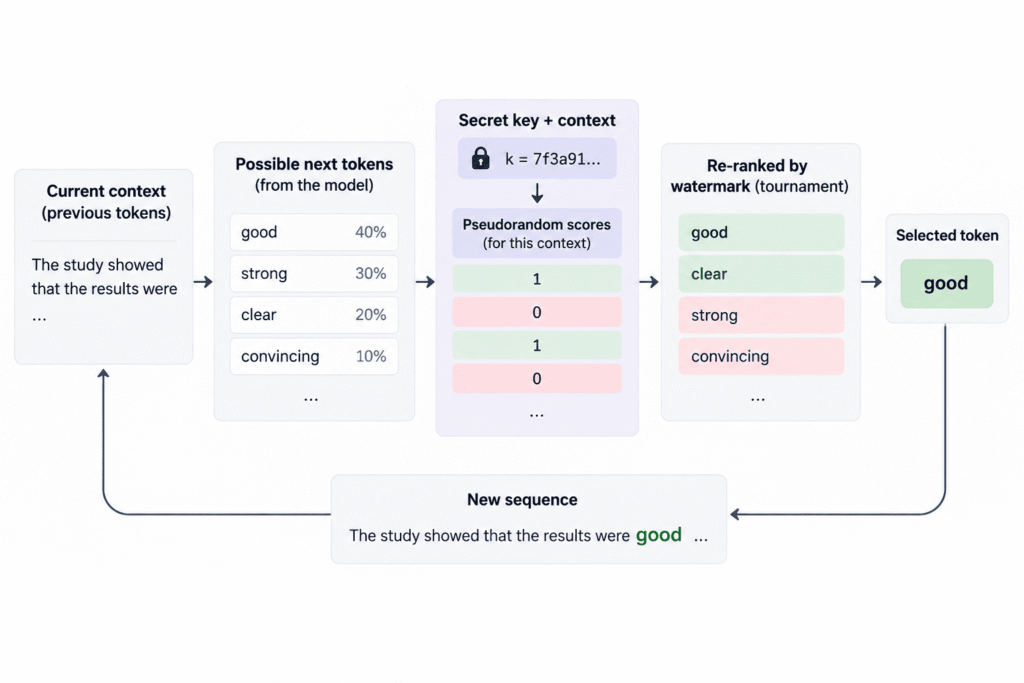
Claude does not decide on an entire sentence at once, but generates text token by token. Imagine the model has written: “The results of the study were…”
Based on everything that came before, Claude calculates probabilities for possible next tokens.
Maybe “good” has a relatively high probability. “Strong” might also work. So might “clear.”
Normally, the model samples from those possibilities according to its generation settings.
With SynthID-style watermarking, that process is subtly modified. It adjusts the model’s token scores using a pseudorandom function before the final token is selected.
In simple terms, the watermark change very slightly the token choices in your text.
That doesn’t mean there is a list of “watermarked words”
The pattern depends on the preceding text and the private watermark configuration.
Instead of asking:
“Does this paragraph contain a secret Claude word?”
the detector asks something closer to:
“Are these token choices unusually consistent with Claude’s watermark pattern?”
That means some watermarked texts are more detectable than others
A two-sentence Claude response contains relatively few token choices. A 2,000-word article contains thousands.
That gives a detector much more information to work with.
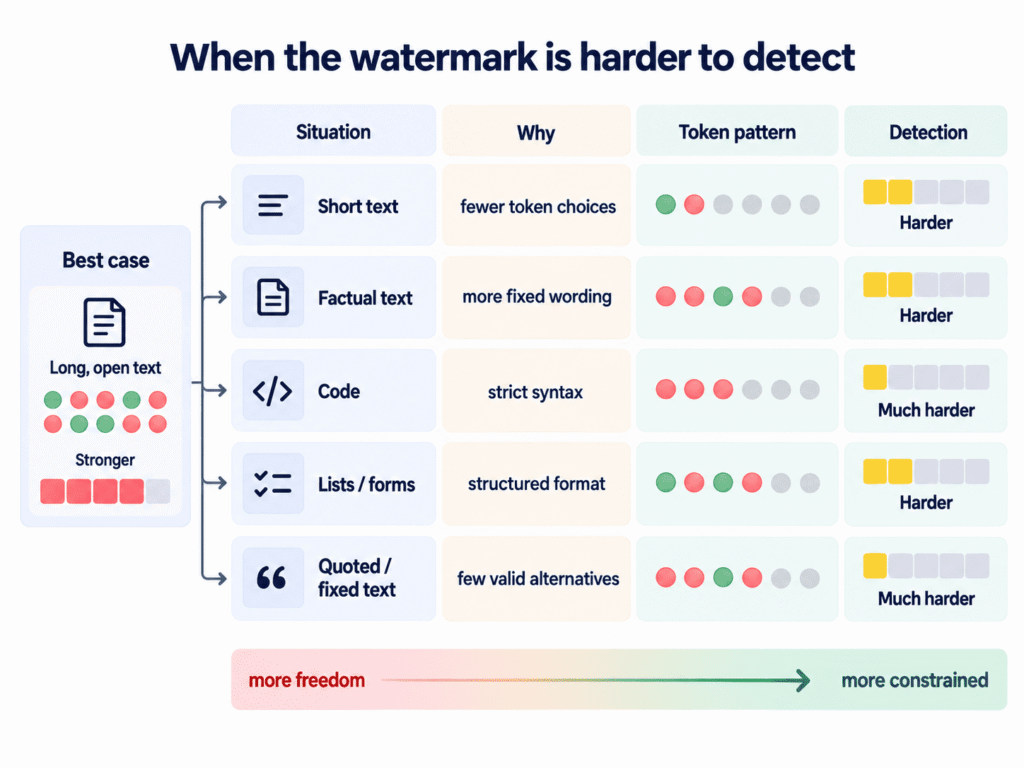
Anthropic explicitly says watermark detection is less reliable on short passages and becomes more confident as the amount of text increases.
So if Claude generates an entire long-form article, there is more opportunity for the watermark pattern to accumulate than if it writes one headline.
Watermarking is also sparser in factual passages. The same issue applies to highly constrained content such as code and exact factual answers.
Can You Remove a Claude Watermark?
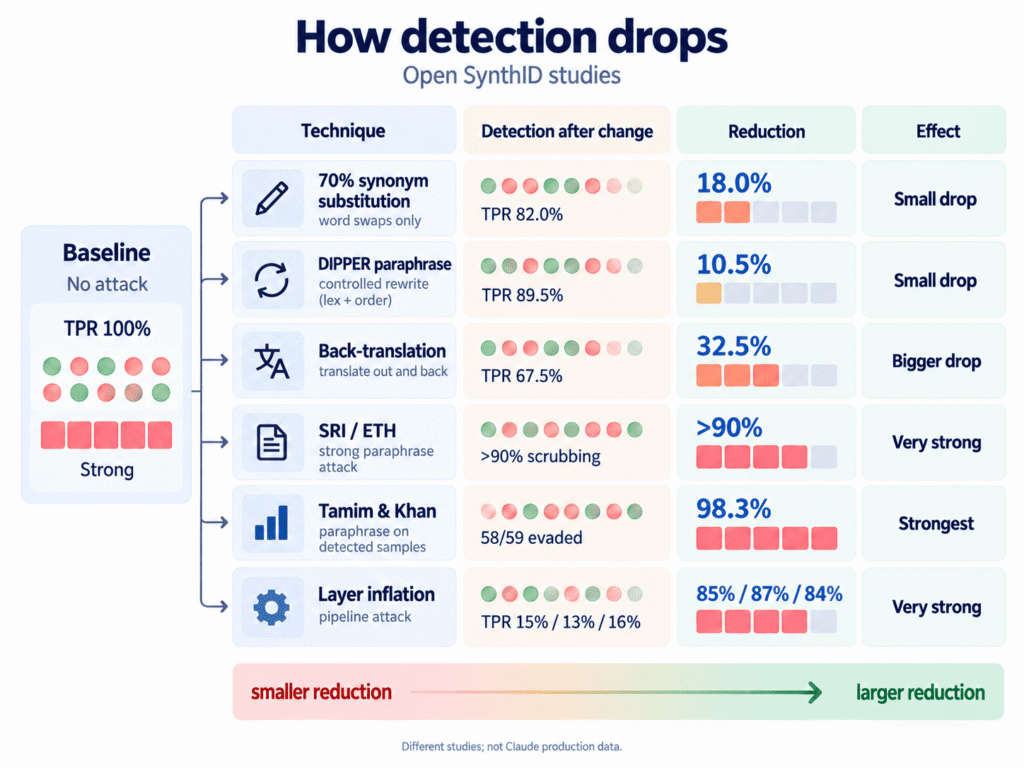
Yes, editing can weaken a Claude watermark.
But light editing will probably leave much of the signal intact.
Simple synonym replacement probably won’t do much
The first instinct might be to replace a few obvious words. That is unlikely to transform the text enough.
The reason is simple: most of the original token sequence is still there.
And because Claude’s watermark is statistical rather than based on a fixed list of secret words, there is no specific “watermarked vocabulary” you can hunt down and replace.
Translation and paraphrasing change much more
A 2025 robustness study found that paraphrasing and back-translation could significantly reduce SynthID-Text detectability.
A translation can change:
- vocabulary;
- word order;
- sentence boundaries;
- grammar;
- punctuation.
So instead of modifying a handful of tokens, you are creating a new sequence that preserves the meaning while changing much of the linguistic structure.
A 2026 forensic study found even larger drops after paraphrasing in the SynthID implementation it tested.
“AI humanizers” are the best way right now to remove Claude watermarks
So-called “AI humanizers” rewrite the text more aggressively.
They may change sentence structure, vocabulary, rhythm, clause order, and punctuation while trying to preserve the original meaning.
That level of rewriting signifincally weaken the statistical watermark.
How to Detect a Claude Watermark

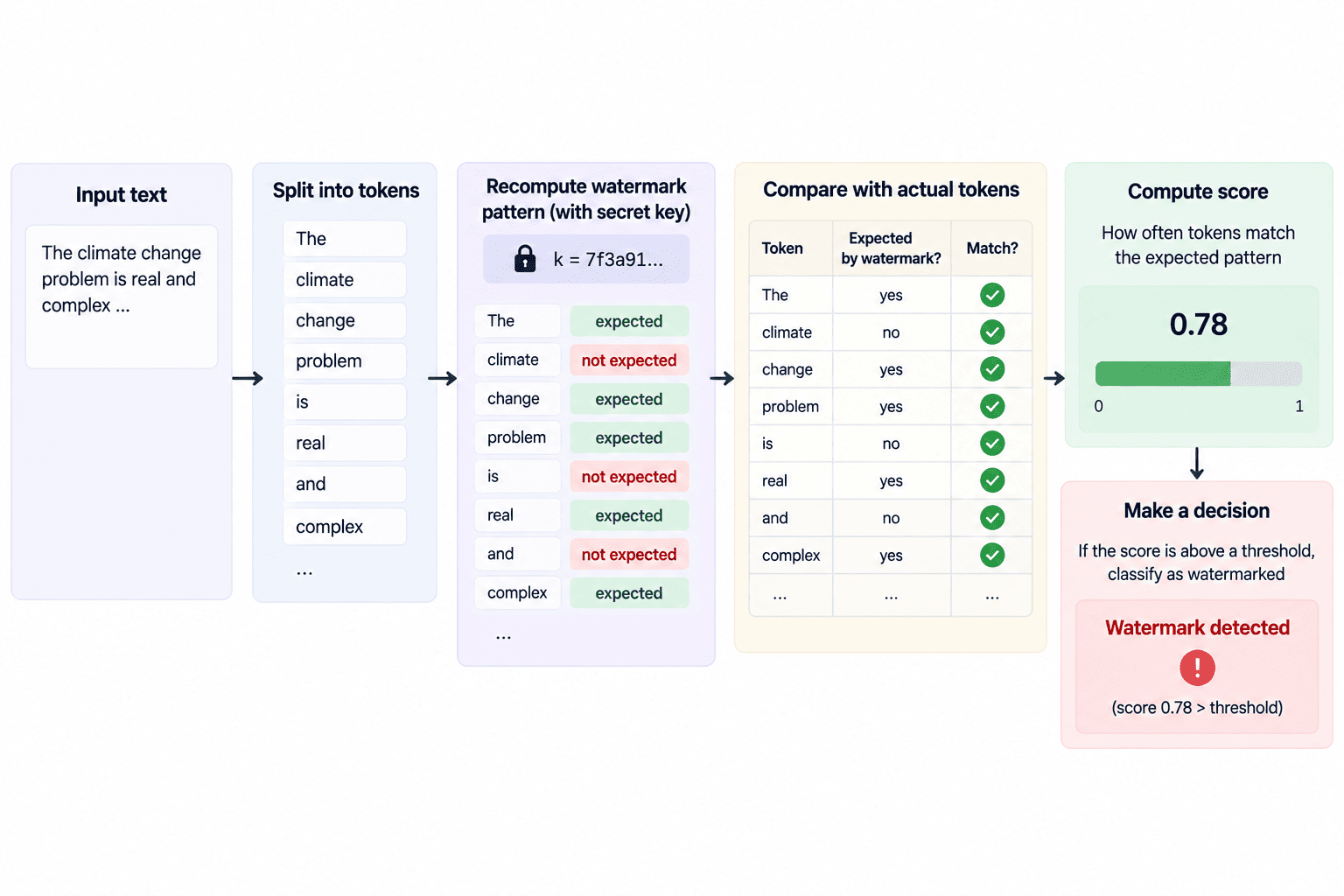
Claude’s watermark is based on a private statistical key.
So even if you know exactly how SynthID-Text works in theory, you still need access to Anthropic’s detection system to check whether a specific passage contains Claude’s actual watermark.
Anthropic is currently rolling out a dedicated detection API for Claude-generated text.
The detector analyzes the token sequence and checks whether those choices are statistically consistent with Claude’s watermark.
But as of September 2026, that detector is still in private preview.
Access is currently available mainly to eligible organizations such as:
- educational institutions;
- researchers;
- regulators;
- media organizations;
- fact-checkers;
- law enforcement;
- some enterprises with compliance obligations.
FAQ
Does Claude really watermark its text?
Yes.
Anthropic has officially introduced text watermarking for supported Claude models using a system based on Google DeepMind’s SynthID-Text.
The watermark is created during generation by subtly influencing Claude’s token choices.
It is not something added afterward.
Is every Claude response watermarked?
Not necessarily.
Anthropic is rolling the system out across supported models and surfaces.
So you should not assume that every Claude response ever generated contains the watermark.
The model version, date, and platform can matter.
Is the Claude watermark a hidden character?
No.
There are no invisible Unicode characters or secret symbols that you can reveal by highlighting the text.
The watermark exists in the statistical pattern of token choices.
That is why simply changing formatting does nothing.
Does copying and pasting remove the watermark?
No.
Copying Claude text into:
- Google Docs;
- Word;
- Notion;
- an email;
- a CMS;
does not fundamentally change the sequence of words.
So the statistical signal can remain.
Changing fonts, removing formatting, or saving the document in another file format has the same problem.
Can ChatGPT or an AI detector find Claude’s watermark?
Not automatically.
Most public AI detectors are looking for stylistic patterns associated with machine-generated writing.
Claude’s official watermark detector looks for a specific statistical signal produced during generation.
These are different systems.
A normal detector reporting “AI-generated” does not mean it found Claude’s watermark.
And a “human” result does not prove the watermark is absent.
Can Claude’s watermark identify my account?
No.
The watermark is not designed to contain your name, Claude account, organization, prompt, or conversation ID.
It indicates that Claude may have been involved in generating or processing the text.
It does not tell the detector who used Claude.
Does Claude watermark code?
Potentially, but the signal can be weaker.
Watermarking works best when the model has several reasonable token choices.
Code is much more constrained.
Sometimes there is only one correct function name, symbol, or syntax structure.
That gives the watermark fewer opportunities to influence generation.
The same problem appears in mathematics and highly factual writing.
What if I only use Claude for proofreading?
That can be different from asking Claude to rewrite an entire article.
If Claude only changes punctuation or corrects a few sentences, most of the original text remains yours.
There may therefore be too little Claude-generated material for strong watermark detection.
If you ask Claude to rewrite every paragraph, however, it makes far more token choices.
Can editing remove the watermark?
Editing can weaken it.
Small changes are less likely to have a major effect because most of the original token sequence remains intact.
Substantial rewriting changes much more of that sequence.
Published research on SynthID-style watermarking has shown that aggressive paraphrasing and similar transformations can reduce detectability.
That does not mean there is a guaranteed method for defeating Anthropic’s actual production detector.
Can I test my text for the watermark myself?
For most people, not reliably yet.
Anthropic’s dedicated watermark detection system has not been released as an unrestricted public checker.
That means consumer tools claiming to detect or remove the Claude watermark with certainty should be treated cautiously.
Does no watermark mean the text is human-written?
No.
A detector might fail because the passage is short, factual, heavily edited, or generated by a model that does not use Claude’s watermark.
And text could still be AI-generated by another model entirely.
So the watermark should be treated as one provenance signal, not absolute proof of who wrote a document.
That is probably the most important point.
Claude watermarking can provide evidence of AI involvement.
It cannot tell the entire story behind how a piece of writing was created.
Get Rid of AI Slop
Get the free AI Humanizer and ready-to-use humanizing prompts.
Get the Free Toolkit
Buchert Jean-marc
Confirmed AI content process expert. Through his methods, he has helped his clients generate LLM-based content that fit their editorial standards and audiences expectations.
All Posts