

Table of Contents
- Reason 1: Your Writing Is Too Predictable
- Reason 2: Your Sentences Are Too Repetitive
- Reason 3: Your Writing is Full of AI-like Expressions
- Reason 4: Your Vocabulary is Too AI-like
- How to Edit AI Text to Make it Undetectable
- 1. Inject your thinking into AIs
- 2. Diversify Outlines
- 3. Actively break rhythm while editing
- 4. Prefer judgment over neutrality
- 5. Implement concrete details
- 5. Accept that some manual editing is unavoidable
Sometimes your writing gets flagged as AI-generated, even when you’ve put effort into making it unique.
That’s definitely frustrating.
In this article, we’ll understand why detectors might classify your content as AI, and the steps you can take to make your text undetectable.
Reason 1: Your Writing Is Too Predictable

If your text is being flagged as AI, the first thing you should look at is predictability. This is the most common reason, and it’s also the most misunderstood.
Large language models like ChatGPT, Gemini, or Claude are built to do one thing extremely well: predict the next most likely word in a sequence. Every sentence they generate is the result of probability. The safest word wins.
The problem is that AI detectors are built on the exact same logic. They don’t try to guess who wrote the text. They measure how predictable the text is. This concept is known in research as perplexity.
Low perplexity means the next word is easy to guess.
High perplexity means the writing surprises you.
AI-generated text almost always has low perplexity by default.
Think of openings like:
“In today’s fast-paced world, businesses are constantly looking for ways to improve efficiency and stay competitive.”
That sentence isn’t wrong. But it’s extremely predictable. Every word follows the most likely path. And detectors love that kind of regularity.
Reason 2: Your Sentences Are Too Repetitive

Large language models struggle with one very human skill: structural variation.
They’re good at writing correct sentences. They’re bad at mixing them in unpredictable ways.
This is what researchers call burstiness.
Human writing is uneven. Messy. Sometimes long. Sometimes abrupt.
Here’s a pattern detectors love to catch:
- Every sentence is roughly the same length
- Each paragraph contains the same number of sentences
- Each section follows the same internal logic
- Bullet lists repeat the same count and structure
You’ll often see this in AI-generated articles:
- A section title
- A short intro sentence
- Three bullet points
- A one-sentence takeaway
Then the next section does exactly the same thing.
Reason 3: Your Writing is Full of AI-like Expressions

AI also relies heavily on rhetorical templates. These are sentence shapes it has learned are “safe,” persuasive, and broadly accepted. The issue is that humans don’t rely on the same templates so consistently.
Some of the most common ones:
- Tricolons: lists of three elements “research, collaboration, and problem-solving”
- Paired constructions: “not only … but also …”
- Balanced oppositions: “both X and Y”
- Over-polished transitions: “This approach highlights the importance of…”
None of these are wrong. The problem is frequency.
When these patterns appear again and again in the same text, detectors pick them up as statistical markers of AI.
Reason 4: Your Vocabulary is Too AI-like

Large language models have favorite words. Not consciously, of course, but statistically.
AI writing models are trained and refined using massive amounts of reviewed content. During that process, some words are repeatedly rewarded because they:
- sound neutral
- sound authoritative
- feel broadly acceptable
- avoid strong opinions
The result is a distinct lexical profile. A set of words that show up again and again across AI-generated articles, regardless of topic.
You’ll recognize many of these immediately:
- “delve into”
- “explore”
- “crucial”
- “well-known”
- “unlock”
- “intricate landscape”
- “in today’s fast-paced world”
- “it’s important to note that”
- “let’s face it”
- “the truth is”
Individually, these phrases are harmless. Together, they form a pattern.
AI also leans heavily on inflated adjectives:
- “unprecedented”
- “revolutionary”
- “transformative”
- “profound shift”
- “unparalleled efficiency”
Human writers tend to be more restrained. Or more specific. AI is neither. It exaggerates safely.
How to Edit AI Text to Make it Undetectable
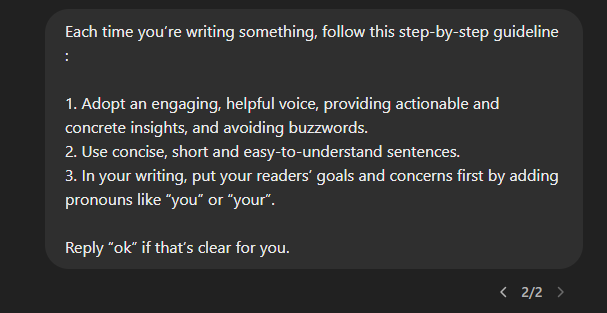
1. Inject your thinking into AIs
The biggest mistake is starting from a blank prompt and asking AI to “write an article about X.”
That guarantees predictability.
Instead, start by writing something yourself. It doesn’t have to be polished. Bullet points are fine. Half-formed thoughts are fine. Strong opinions are even better.
What matters is that you inject:
- perspective
- constraints
- intent
For example, instead of prompting:
“Write an article about AI detection.”
Give context:
“I’m frustrated because my manually written content keeps getting flagged. I want to explain why detectors get it wrong, using concrete examples from my own work.”
When AI expands your thinking, it mirrors your irregularity. That alone raises perplexity and lowers detection risk.
2. Diversify Outlines
AI loves symmetry. Humans don’t.
If your outline looks like this:
- Introduction
- Reason 1
- Reason 2
- Reason 3
- Conclusion
You’re already setting yourself up for structural repetition.
A better outline mixes intent:
- A personal frustration
- A technical explanation
- A concrete example
- A counterintuitive insight
- A practical takeaway
Different sections should do different jobs. Some explain. Some argue. Some illustrate. Some question.
When you give AI an uneven outline, it can’t fall back on its default patterns.
3. Actively break rhythm while editing
This is where most people stop too early.
After generation, read your text only for rhythm:
- Are sentences similar in length?
- Do paragraphs end the same way?
- Do transitions feel “too smooth”?
If yes, break them.
- Add a short sentence.
- Merge two sentences into one long one.
- Add/Remove bullet points, subsections
4. Prefer judgment over neutrality
AI love balancing arguments and hate taking a stand.
AI says :
“There are arguments on both sides.”
While humans say:
“This argument sounds convincing until you test it against reality.”
So you should add what I call “opinionated expressions”:
- I think, I believe, I argue…
- Probably, certainly, there’s a great chance…
- From my experience, in my mind, well, actually,…
5. Implement concrete details
AI is great at generalization. It’s bad at lived specifics.
Add:
- time (“last month”, “after three edits”)
- friction (“this part took longer than it should have”)
- limitation (“this works only if…”)
Detectors struggle with text that contains constraints and trade-offs, because those reduce statistical smoothness.
5. Accept that some manual editing is unavoidable
This is the part many people resist.
You cannot fully automate humanization. AI can assist. It cannot replace judgment.
The good news is that you don’t need to rewrite everything. Most detection improvements come from:
- the first paragraph
- section transitions
- sentence rhythm
- vocabulary cleanup
Fix those, and detection scores often drop dramatically.
Here it is, now you know what to do when your Content is being flagged as AI-generated !
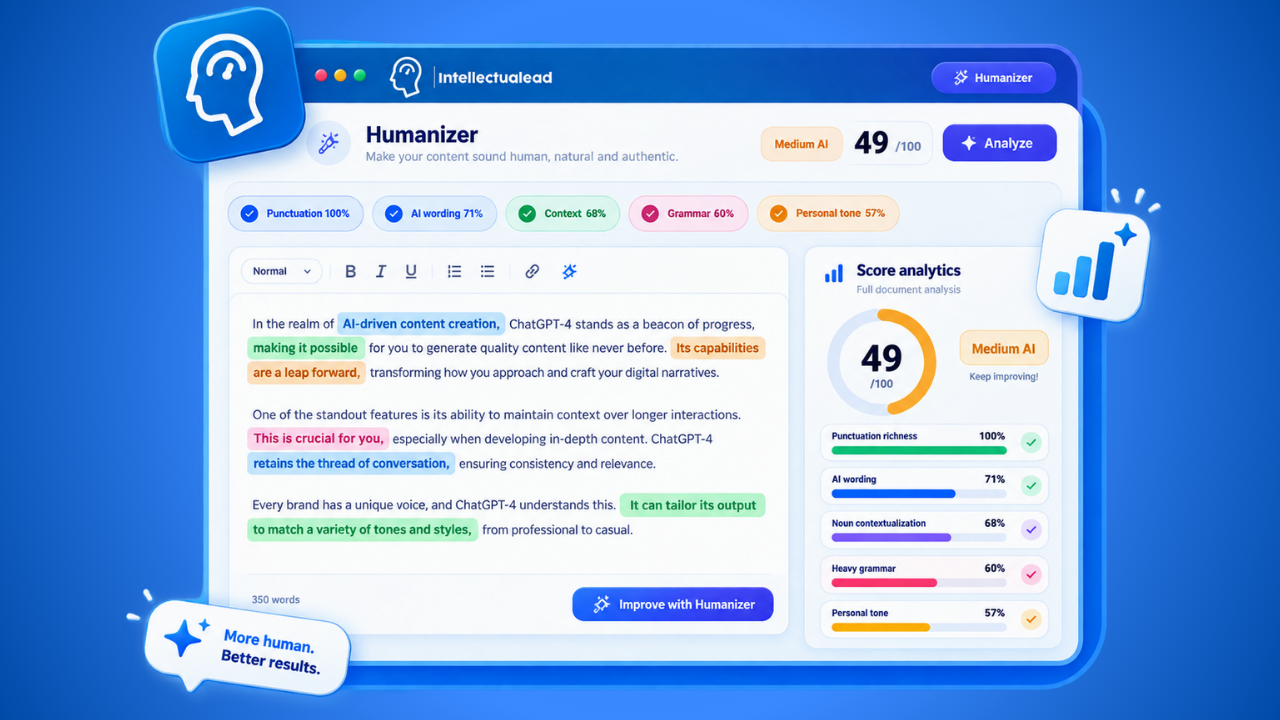
Get Rid of AI Slop
Get the free AI Humanizer and ready-to-use humanizing prompts.
Get the Free Toolkit
Buchert Jean-marc
Confirmed AI content process expert. Through his methods, he has helped his clients generate LLM-based content that fit their editorial standards and audiences expectations.
All Posts