
Table of Contents
“Is Gemini 3 good for writing?” this isn’t definitely a theoretical question.
Writing quality only becomes clear when a model is forced to handle real tasks.
In this article, you’ll see Gemini 3 evaluated the way you actually use AI.
Gemini 3 Writing Benchmarks and Leaderboards
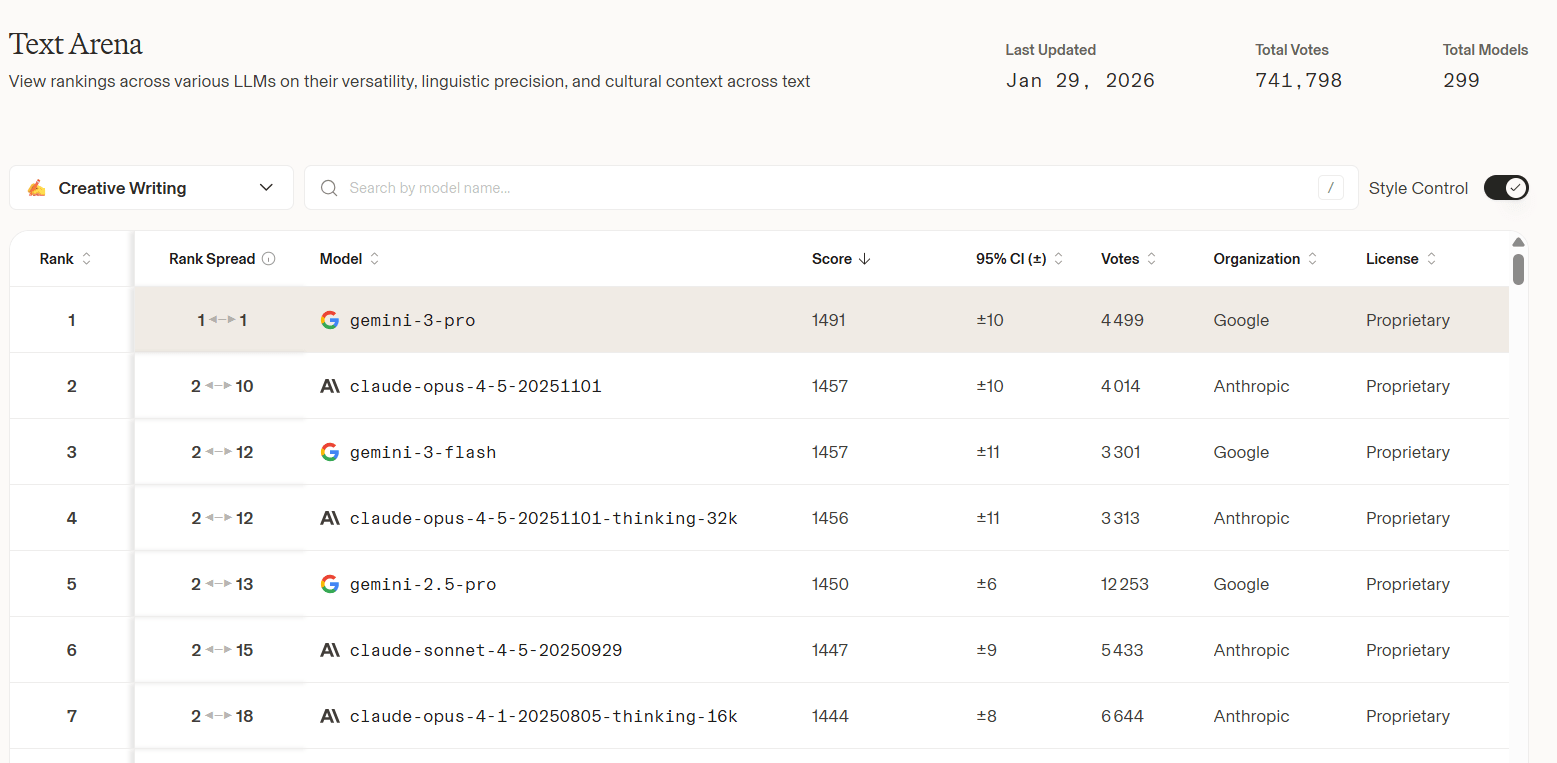
The most useful reference point right now is LMArena (formerly Chatbot Arena).
It works like this: two anonymous models answer the same prompt side-by-side, humans vote for the better answer, and the leaderboard updates using an Elo-style rating system.
On LMArena’s Text Arena, gemini-3-pro ranks #1 with a score of 1492 (95% CI ±6) based on 15,871 votes in december 2025.
On the specific Creative Writing section, gemini-3-pro still ranks #1 with a score of 1493 (±14).
So looks like it is state of the art in this matter.
Gemini 3 Writing Analysis and Vibe check
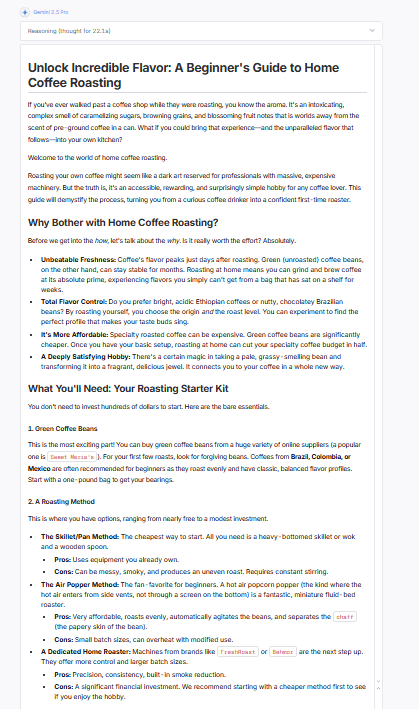
The first place Gemini 3 stood out for me was idea generation.
When I ran my standard log line prompt, Claude’s outputs felt familiar. Competent, but full of tropes I’ve seen many times before. Gemini 3, on the other hand, gave me ideas that were more surprising. Not always perfect, but more likely to make me pause and think, “Okay, that’s interesting.
Outlines: Gemini is succinct, Claude is exhaustive
When I moved on to outlines, the difference became very clear.
Claude Opus 4.5 gave me a massive, extremely detailed outline. Chapter breakdowns, character arcs, themes, even series setup ideas I hadn’t asked for. From a reasoning standpoint, it was impressive.
But for my workflow, that level of detail is a mixed blessing.
I prefer outlines that give me structure without locking me in too early. Gemini 3’s outlines were shorter, cleaner, and easier to reshape. I could see the story or article clearly, but I still felt like I was in control.
Prose: Gemini is cleaner, Claude is more dramatic
This is where things get nuanced.
Claude’s prose often feels richer on first read. It leans into drama, internal monologue, and repetition as a literary device. That can be very effective in high-impact scenes.
But I’ve used Claude heavily in the past, and I’ve learned that some of its habits get old over time. The repeated motifs. The heightened emotional intensity in moments that don’t really need it. I find myself cutting the same kinds of lines again and again.
Gemini 3’s prose is different. It’s more restrained. Sometimes a bit rushed. But it’s also easier to live with over longer stretches of text.
What surprised me most is how responsive Gemini 3 is to style input. When I give it detailed style guides and writing samples, it actually changes its output significantly. Claude shifts too, but not as dramatically in my experience.
Dialogue and editing: Gemini moves the text forward
In dialogue scenes, both models performed well. If I had to pick, I slightly preferred Gemini 3’s dialogue because it felt more dynamic and less overwritten.
Where Gemini really impressed me was editing.
When I gave both models a poor-quality scene and asked them to improve it, Gemini made bigger, more meaningful changes while keeping the logic intact. It felt like a true rewrite, not just a polish pass.
Marketing tasks: Gemini adds structure, Claude adds bulk
On explicitly marketing-oriented prompts, the pattern continued.
- Ad headlines: Gemini grouped headlines into categories (curiosity gaps, ecosystem hooks, etc.) without being asked. That kind of structural thinking is immediately useful.
- Email newsletters: Both models were excellent. I’d call this a tie.
- SEO articles: Claude came closer to my requested word count. Gemini tended to underwrite and overuse keyword bolding, which I’d need to clean up.
That tells me Gemini 3 is better at thinking, while Claude is better at filling space. Depending on your needs, either can be an advantage.
Gemini 3 Vs Alternatives
Here’s how Gemini 3 stacks up against the alternatives (with one I already mentioned)
GPT-5.2: best when your writing task includes planning, tooling, or multi-step work
OpenAI positions GPT-5.2 as a flagship model for complex work, with an official API doc that lists a 400k context window and 128k max output.
For pure prose, GPT-5.2 can be excellent. But its real advantage for content marketers is when “writing” is attached to process:
- building briefs, outlines, and QA checklists
- generating reusable content frameworks (not just one-off drafts)
- turning messy requirements into step-by-step deliverables
Use GPT-5.2 when:
- you want one model to handle planning → drafting → editing in one pass
- your workflow includes artifacts (tables, structured plans, multi-part deliverables)
- you need strong instruction-following across long, multi-step prompts
Watch-outs:
- output can be “too complete” (it finishes the job the way it would, not necessarily your brand’s way) unless you provide strong guardrails
Claude Opus 4.5: best when you want “high-impact writing” without heavy prompting
Claude Opus 4.5 is often the easiest model to get impressive longform out of quickly.
Use Claude when:
- you want strong narrative energy (openings, story-driven sections, dramatic scenes)
- you’re writing thought leadership that needs a confident “voice on the page”
- you prefer a model that adds helpful extras (themes, arcs, expansions) without asking
Watch-outs:
- it can lean dramatic and repeat certain motifs over time (great in a snippet, tiring across a library)
- it may not shift as sharply as Gemini when you feed it a large style guide (so you still need an editor)

Free Prompts and Ebook to Humanize Your Text
Download Now
Buchert Jean-marc
Confirmed AI content process expert. Through his methods, he has helped his clients generate LLM-based content that fit their editorial standards and audiences expectations.
All Posts