

Table of Contents
GPT-6 Astra is clearly one of the most capable frontier models available.
But being a powerful model is not the same thing as being a good writer.
To find out if that’s the case, we will look at the stylistic characteristics of its writing.
GPT-6 Astra writing in the benchmark
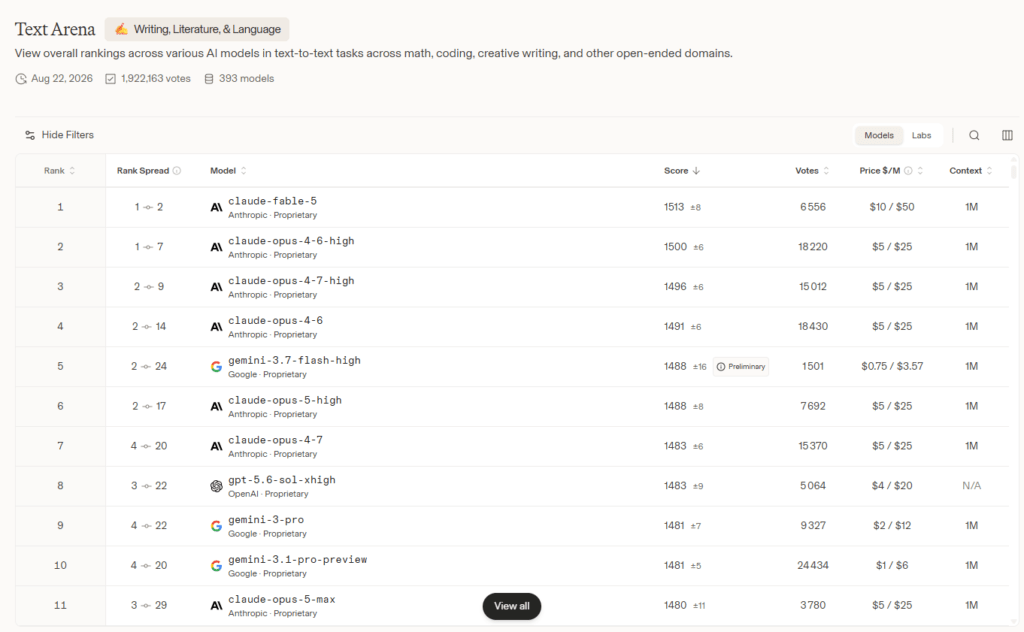
On general capability, Astra is clearly a frontier model.
It performs extremely well on technical, coding, reasoning, and agentic tasks. In the current Agent Arena, GPT-6 Astra Max ranks #2 overall, directly behind Claude Fable 5.1 Max.
But this does not tell you whether the prose sounds natural.
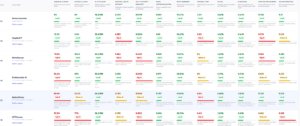
In the stylistic writing benchmark, GPT-6 Astra falls down at roughly 29th place.
At the time of this review, GPT-6 Astra does not yet have a stable position in Chatbot Arena’s Writing, Literature & Language category.
So the benchmarks for writing seems contrasted for GPT Astra.
GPT-6 Astra writing stylistic analysis
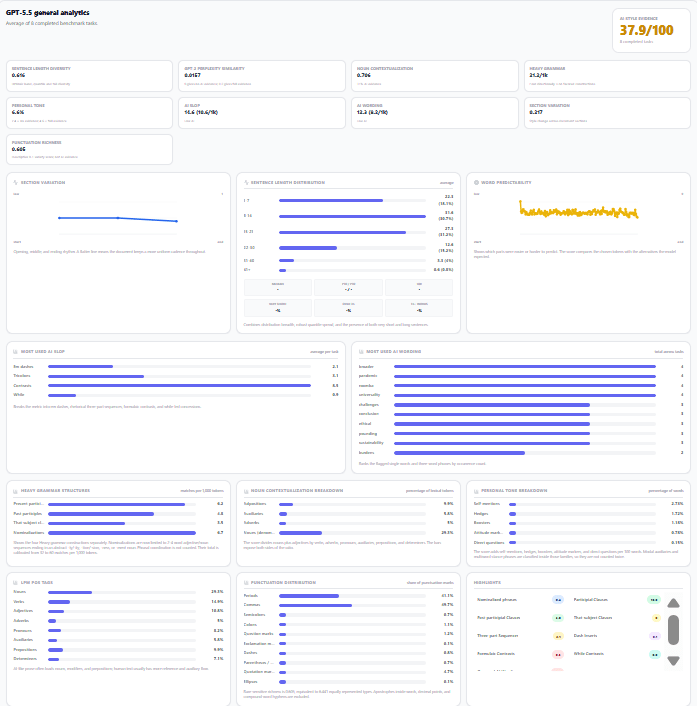
The stylistic benchmark tells us the reasons why Astra’s writing sounds quite bad.
The sentence rhythm is still too uniform
This is probably Astra’s clearest weakness.
In our benchmark, around 60% of the sentences fall between roughly 8 and 21 words.
That is a fairly narrow range.
Long sentences are much less common than in human writing, especially sentences above 30 words. The human baseline contains significantly more of them.
The punctuation is surprisingly limited
OpenAI seems to have reacted to one of the most obvious AI-writing complaints: em dashes.
In our sample, they are basically gone.
The problem is that GPT-6 has not replaced them with richer punctuation.
Instead, periods and commas account for almost 80% of the punctuation.
There are almost no exclamation marks. Semicolons are rare. Dashes are almost absent.
By comparison, the human baseline uses a wider spread of question marks, exclamation marks, semicolons, and dashes.
GPT-6 still relies heavily on nouns
This is another old ChatGPT habit that has survived.
GPT-6 Astra uses roughly 30% nouns, compared with around 26% in the human baseline.
That difference becomes especially visible in formal writing.
In the academic essay sample, Astra stacks phrases around concepts such as:
“economic security”
“eligibility”
“comprehensive social protection”
“trading entitlement”
Too many abstract nouns make the sentence harder to process.
But one good thing : GPT-6 has removed a lot of obvious AI slop
This is probably the biggest improvement.
Older models such as GPT-3.5, GPT-4, and GPT-4o perform poorly in our benchmark partly because their writing contains so many recognizable AI patterns.
GPT-6 Astra uses much less of them.
There are fewer stereotypical words.
Terms such as “universality,” “prioritized,” and “challenges” still appear, but the overall frequency is considerably lower.
Tricolons are less common.
And the familiar “not only X, but also Y” contrast appears much less frequently.
GPT-6 Astra Review & alternatives
GPT-6 Astra is one of the most capable models available.
But if your main priority is writing quality, it would not be my first choice.
The benchmark makes that fairly clear.
Claude Fable 5.1 is the obvious alternative
For pure prose quality, Claude Fable 5.1 is the strongest alternative in this comparison.
The difference is not simply that Claude uses prettier words.
Its writing is structurally more varied.
Sentence lengths move around more naturally. There are more very short sentences and considerably more sentences above 30 words. Its noun distribution also sits closer to the human baseline, while punctuation is more diverse.
That becomes especially noticeable in:
- personal writing;
- fiction;
- biography;
- copywriting;
- subjective essays;
- content where voice matters.
GPT-6 may still be better for the work around the writing
That does not mean you should stop using Astra.
Its strongest advantage may simply be somewhere else.
GPT-6 is built for complex reasoning, research, coding, document creation, and long-running tasks.
So a practical workflow could be:
- use GPT-6 Astra to research the subject;
- organize the sources;
- develop the argument;
- create the factual structure;
- then use Claude or a human editor to work on the prose.
That plays to the strengths of both models.
Get Rid of AI Slop
Get the free AI Humanizer and ready-to-use humanizing prompts.
Get the Free Toolkit
Buchert Jean-marc
Confirmed AI content process expert. Through his methods, he has helped his clients generate LLM-based content that fit their editorial standards and audiences expectations.
All Posts