

Índice de contenidos
- Por qué ChatGPT no escribe como un humano
- 10 prompts para lograr que ChatGPT escriba como un humano
- 1. El prompt de personaje (Persona)
- 2. El prompt de estructura (Outline)
- 3. El prompt de ejemplo (Sample)
- 5. El prompt sorpresa
- 6. El prompt de dinamismo (Burstiness)
- 7. El prompt «Sin palabrería» (No Bullshit)
- 8. El prompt de la experiencia personal
- 9. El prompt factual
- 10. El prompt conversacional
¿Cansado de que el contenido generado por IA parezca robótico y aburrido?
Existen pasos muy prácticos para lograr que ChatGPT escriba de forma mucho más humana.
En esta guía, exploraremos estrategias aplicables para humanizar tus textos generados por IA.
Por qué ChatGPT no escribe como un humano

A pesar de los enormes avances en los LLMs, a ChatGPT todavía le cuesta producir contenido que suene cien por cien humano.
Hay varias razones para ello:
Está diseñado para predecir, no para crear
El trabajo de ChatGPT es simple: predecir la palabra que tiene más probabilidades de seguir a la anterior basándose en patrones aprendidos de miles de millones de ejemplos. Esto significa que se le recompensa por ser predecible, no por ser sorprendente o atrevido. Siempre busca lo estadísticamente promedio.
Esta naturaleza predictiva provoca una falta de dinamismo y variación (o burstiness en inglés): un término que describe la variedad en la estructura y el ritmo de las frases en la escritura humana. Los escritores de verdad mezclan frases cortas y largas. Rompen patrones. Se desvían del tema y luego vuelven al punto principal. ChatGPT, por el contrario, tiende a seguir un ritmo constante que rápidamente suena robótico.
No tiene vivencias ni opiniones reales
Los humanos escriben a partir de sus emociones, intuiciones y experiencias. Has lidiado con proyectos difíciles, cometido errores, visto patrones y aprendido lecciones. ChatGPT no. Puede imitar la experiencia personal («Como profesional del marketing, a menudo me encuentro…»), pero es pura fachada. No hay un rastro emocional ni un punto de vista genuino detrás de sus palabras.
Se entrena con conjuntos de datos específicos y limitados
Otro motivo por el que la escritura de la IA suena genérica son sus datos de entrenamiento. ChatGPT se entrenó con bases de datos masivas que incluyen sitios web públicos, libros, artículos y recursos educativos. Esto significa que gran parte de su «voz» proviene de contenido de marketing e instructivo, el tipo de texto que domina internet.
Así que, naturalmente, escribe así: un tono pulido, hiperbólico e impersonal. Abusa de los típicos clichés del marketing («cambia las reglas del juego», «revolucionario», «desbloquea tu potencial») y de estructuras predecibles como:
- Tricolones: repetir tres elementos seguidos («claro, conciso y convincente»).
- Transiciones pareadas: «no solo… sino también», «en el mundo acelerado de hoy…».
- Uso excesivo de guiones largos, que suele meter para sonar más dramático.
10 prompts para lograr que ChatGPT escriba como un humano
El resultado por defecto de ChatGPT no siempre suena muy natural, pero con unos buenos prompts puedes solucionarlo.
Aquí tienes 10 prompts para mejorar el tono y el estilo de ChatGPT:
1. El prompt de personaje (Persona)

Sin un personaje asignado, ChatGPT escribe como un educado bot informativo. Pero con una personalidad clara, se convierte en alguien específico: una persona con contexto, valores y un tono de voz. Esto lo cambia todo: la longitud de las frases, el vocabulario y cómo se dirige al lector.
Plantilla del prompt
Eres un [rol] escribiendo para [público objetivo].
Escribe con un tono claro y conversacional usando "tú" y "tu".
Usa frases cortas y mezcla diferentes longitudes para darle ritmo.
Evita los clichés, las palabras de moda y el relleno formal.
Prioriza los verbos concretos y los ejemplos sobre las afirmaciones generales.
Debes sonar experimentado pero cercano.
Personaliza estas directrices según el estilo y tono que busques.
2. El prompt de estructura (Outline)

Cuando le pasas a ChatGPT un esquema, lo obligas a trabajar dentro de tu propia lógica en lugar de usar sus atajos predeterminados. Tú decides la estructura y el flujo de las ideas.
Plantilla del prompt
Escribe un borrador para un contenido sobre *tu tema* basándote en mi esquema: 1. 2. 3. 4.
3. El prompt de ejemplo (Sample)
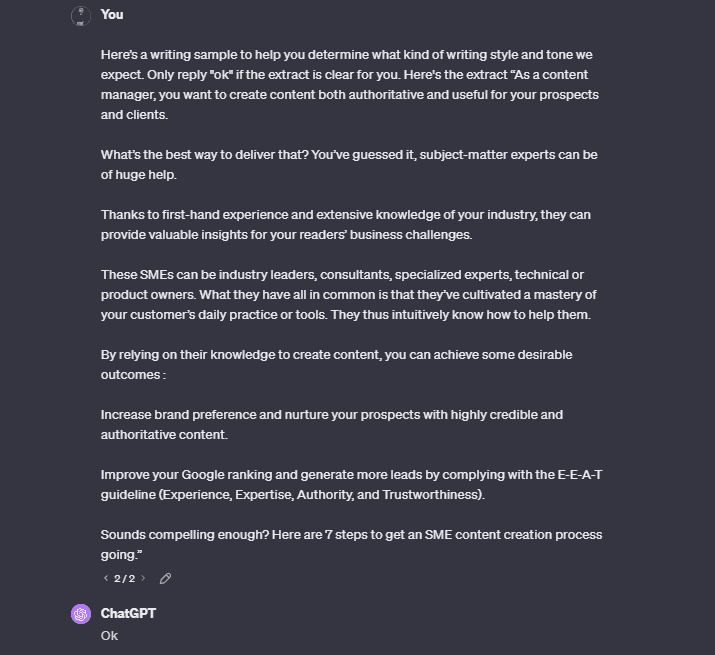
Una forma aún más rápida de conseguir que ChatGPT hable como tú es darle un pequeño extracto de cómo escribes. Funciona mucho mejor que simplemente darle instrucciones, ya que a ChatGPT se le da genial imitar.
Aquí tienes una muestra de escritura para ayudarte a determinar qué tipo de estilo y tono espero. Responde solo 'ok' si el extracto te ha quedado claro. Aquí tienes el texto:
4. El prompt de opinión
A ChatGPT le encanta el copy neutral y seguro, por eso es tan olvidable. Cuando le pides que tome partido (y que explique el porqué), el texto gana tensión y personalidad. Suena infinitamente más humano.
Plantilla del prompt
Adopta una postura clara sobre este tema. Explica tu razonamiento y los pros y contras.
Usa la primera persona ("yo") si ayuda a dar contexto al punto de vista. Incluye un ejemplo específico.

Tema:
"[tu tema]"

Reglas:
- Sé directo. Nada de lenguaje evasivo o ambiguo.
- Mantén los párrafos en un máximo de 4 líneas.
- Evita exageraciones, clichés y tricolones.5. El prompt sorpresa
La IA suele darte solo ángulos esperables, resúmenes prolijos y las conclusiones que todo el mundo ya ha leído. Este prompt obliga a ChatGPT a buscar enfoques poco comunes sobre el tema.
Plantilla del prompt
Dame 3 enfoques poco obvios sobre "[tema]".
Para cada uno: una tesis de una sola frase, una comparación o metáfora original y un ejemplo concreto.
Sin clichés ni palabrería promocional. Lenguaje claro y directo. Frases cortas.
6. El prompt de dinamismo (Burstiness)
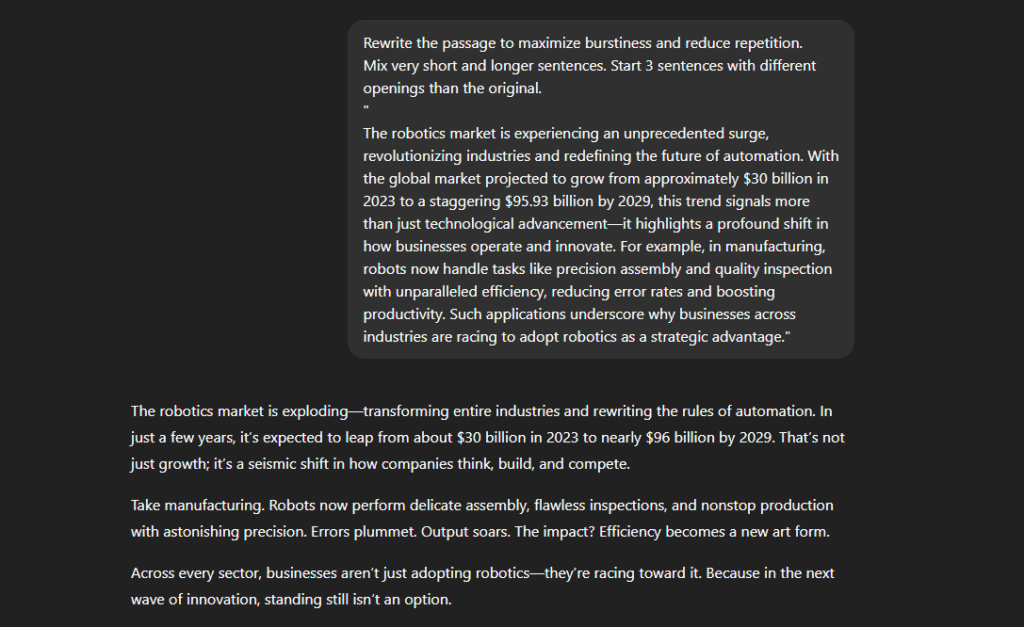
Los textos de la IA suelen estancarse en un ritmo monótono: frases de longitud media, estructuras de párrafos simétricas, transiciones predecibles. El lector acaba desconectando. Romper este patrón devuelve la cadencia, el contraste y la fuerza. Quieres golpes cortos. Luego una línea más larga que desarrolle una idea. Luego un ejemplo para cortar. Luego una pregunta. Esa mezcla es la que hace que el texto cobre vida.
Cómo funciona:
Estableces reglas que controlan el ritmo y prohíben las muletillas repetitivas. También fuerzas variedad a nivel de palabras: aperturas distintas, verbos variados, menos reformulaciones.
Plantilla del prompt
Reescribe el pasaje para maximizar el dinamismo (burstiness) y reducir la repetición.
Mezcla frases muy cortas con otras más largas. Empieza 3 frases de forma diferente a como lo hace el original.
7. El prompt «Sin palabrería» (No Bullshit)
A menudo, el contenido generado por IA incluye palabras de moda y frases hechas que hacen que el texto suene insincero y demasiado promocional.
Para que la escritura de ChatGPT sea más auténtica y profesional, enfócate en identificar y eliminar estas palabras «vacías».
Plantilla del prompt
Reemplaza los verbos vagos por acciones concretas.
Elimina las reformulaciones ("en otras palabras", "dicho de otro modo").
Limita los guiones largos. Nada de tricolones. Nada de "no solo... sino también".
Aléjate de la paja: Evita adjetivos y adverbios innecesarios.
No uses un lenguaje hiperbólico o promocional.
Evita las frases típicas de la IA: No uses clichés como "sumérgete en", "desata tu potencial", etc.
Habla más en primera persona; dirígete a los lectores de "tú". 8. El prompt de la experiencia personal
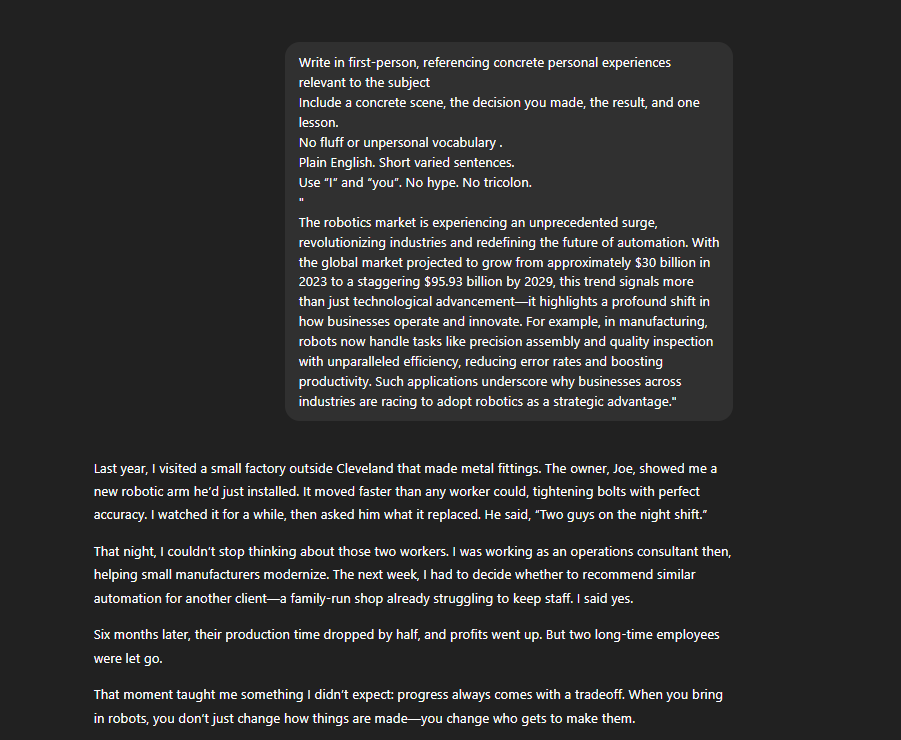
La IA puede imitar la experiencia, pero rara vez logra plasmar los detalles que hacen que una anécdota parezca real. Este prompt le pide a ChatGPT que escriba en primera persona utilizando escenas específicas, decisiones y resultados que tú le aportas como notas.
Plantilla del prompt
Escribe en primera persona, haciendo referencia a experiencias personales concretas relevantes para el tema.
Incluye una escena específica, la decisión que tomaste, el resultado y un aprendizaje.
Nada de relleno o vocabulario impersonal.
Lenguaje claro y directo. Frases cortas y variadas.
Usa "yo" y "tú". Sin exageraciones. Nada de tricolones.
9. El prompt factual
A la IA le encantan las generalizaciones suaves. A tu lector no. Lo que quieren son datos específicos, fuentes contrastables y números con contexto.
Plantilla del prompt
Escribe esta sección utilizando únicamente los datos proporcionados y las fuentes encontradas.
Indica los números en un lenguaje claro (numerador/denominador/periodo de tiempo).
Revisa y enlaza cada dato a la referencia correcta.
Si falta algún dato necesario, escribe: "Falta: [qué]" y sugiere dónde encontrarlo.

Reglas:
- Nada de datos inventados. Nada de afirmaciones vagas.
- Un ejemplo que aplique un dato a una decisión real.
10. El prompt conversacional
A menudo, la IA escribe como si estuviera dando una clase, no dirigiéndose a una persona. Se percibe una distancia: transiciones cautelosas, frases neutrales, ausencia de preguntas. Pero los lectores quieren sentir que están charlando con alguien que los entiende.
Plantilla del prompt
Escribe esta sección como si estuvieras charlando con un amigo.
Haz 1 o 2 preguntas breves para mantener su atención.
Usa un lenguaje llano y coloquial.
Divide las ideas largas en frases más cortas.
Añade un poco de charla ligera y alguna pequeña digresión justificada.

Prompts gratuitos y Ebook para humanizar tu texto
Descargar ahora
Buchert Jean-marc
Experto confirmado en procesos de contenido de IA. A través de sus métodos, ha ayudado a sus clientes a generar contenido basado en LLM que se ajusta a sus estándares editoriales y expectativas de la audiencia.
Todos los artículos