

Table of Contents
Readers can easily detect overly robotic, formulaic writing so common of LLMs.
Thankfully, a range of AI humanizer tools are available to bridge this gap.
In this article, we’ll explore the ten best AI humanizers that help you elevate your content from generic to genuinely impactful.
| Rank | Tool | Best For | Key Technique | Bypass Performance | Pricing |
| #1 | GPTHuman | Overall Balance (Quality + Bypass) | Tones down hyperbole & breaks up overloaded sentences. | Bypass GPTZero on 3/4 samples | ~€15/mo |
| #2 | Undetectable AI | Structured Content (SEO & Essays) | Aggressive simplification & heavy use of transition words. | Bypass GPTZero on 3/4 samples | $14.99/mo |
| #3 | StealthGPT | Creative/Personal (Claude Users) | Adds opinion, emotion, and conversational explanations. | Bypass GPTZero on 3/4 samples | ~$32/mo (Weekly billing) |
| #4 | StealthWriter | Light Editing | Swaps specific “AI words” while keeping original structure. | Bypass GPTZero on 2/4 samples | ~$20/mo |
| #5 | WriteHuman | Short Copy | Aggressive shortening & plain language. | Bypass GPTZero on 2/4 sample | ~$27/mo |
| #6 | QuillBot | General Paraphrasing | Synonym swapping with low structural disruption. | Failed all tests. (0% Human score). | Free / $19.95/mo |
Our Testing Method
We tested humanizers on four samples from different LLM models :
- GPT-4 (legacy): older output with obvious AI patterns. This is useful because many humanizers were built to target exactly these patterns.
- GPT-4.2 Thinking + Search: more structured and fact-heavy writing. This is closer to what you get when you generate SEO content with citations and a clear outline.
- Gemini 3 Pro Thinking + Search: different rhythm and phrasing from OpenAI models, and often more formal by default.
- Claude Sonnet 1.5: a distinct style again, with its own habits (long sentences, smooth transitions, sometimes too polished).
We ran each humanized samples from each humanizer through GPTZero as the detector check. That way, we measured and compared the bypass rate of each humanizer.
We also analyzed the output quality of each humanizer and the humanization techniques they used.
Did the humanization degrade the quality of the writing and add unecessary noise? Or did it make it more readable and human-sounding ?
#1 GPTHuman
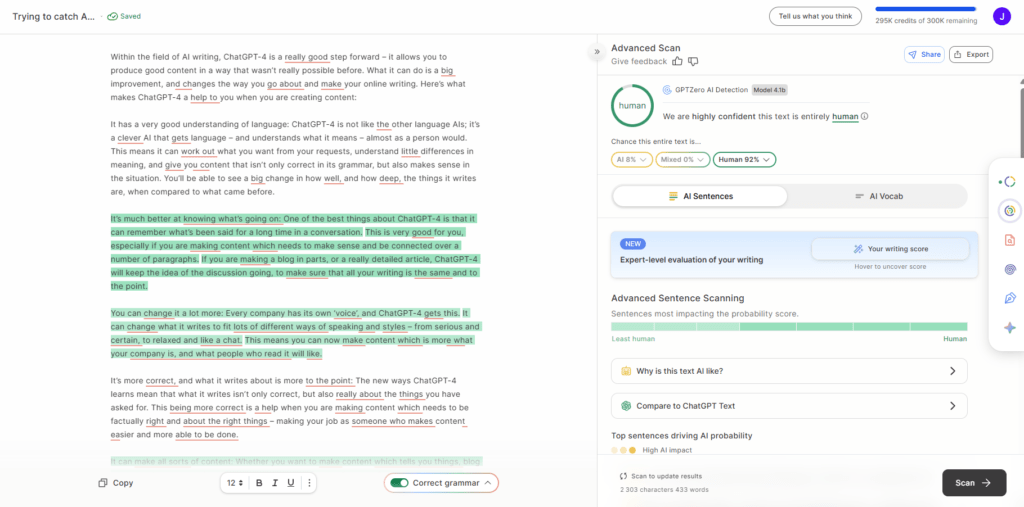
GPTHuman finds a good balance between bypass capability and output quality. That’s why we put it first in this ranking.
TRY GPTHUMAN FOR FREE HERE
Humanization Technique
1) It tones down hyperbole.
AI loves inflated adjectives: advanced, groundbreaking, profound, remarkable. GPT-Human usually replaces them with more ordinary, believable language.
2) It breaks up overloaded sentences.
AI often crams too many clauses into one line. GPT-Human reduces that “stacking” effect by shortening sentences, trimming side phrases, and keeping one idea per sentence more often.
3) It shifts toward a more casual, active voice.
Instead of noun-heavy constructions, it moves toward simpler subject-verb statements. That change is subtle, but it’s one of the biggest reasons the text reads lighter.
Performance
- On the GPT-4 sample, GPT-Human produced the best result: the output was scored as 92% human by GPTZero. It was the only humanizer in the test set that managed to push that GPT-4 text clearly into “human” territory.
- On the GPT-4.2 Thinking, it performed well at 88% human.
- On the Gemini 3 Pro sample, it failed hard: GPTZero flagged it as 100% AI.
- On the Claude Sonnet sample, the result was mixed: it landed at 54% human,
So GPT-Human wasn’t perfect. But it produced three outputs that leaned human (two strongly, one uncertain), and it did that without destroying readability. That’s why it takes the #1 spot here.
Pricing
GPT-Human sits in the mid-range pricing tier for humanizers.
The starter plan is priced around €15 per month, and it includes a generous word allowance for regular editing use.
#2 Undetectable AI
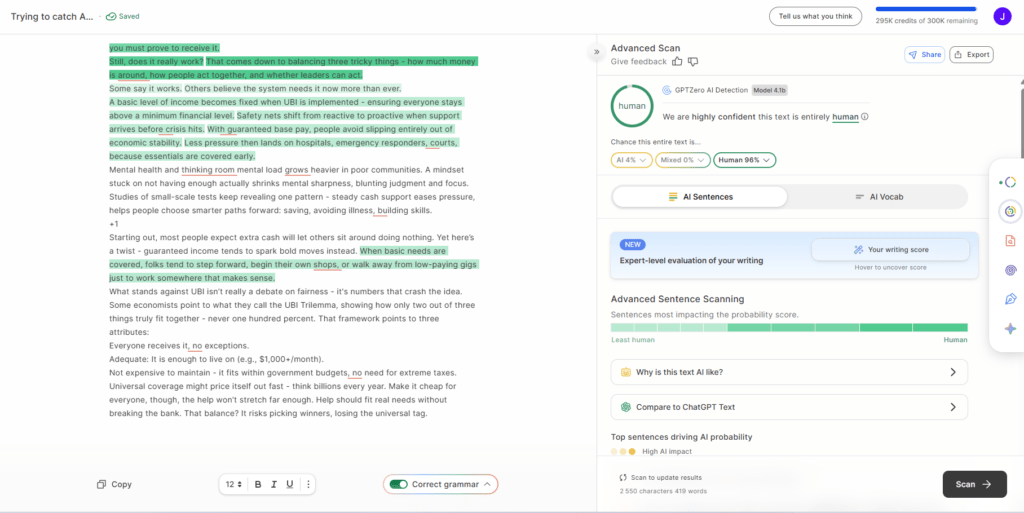
Undetectable AI is one of the best-known humanizers on the market. It’s humanization move is aggressive simplification.
Click here to try Undetectable AI for free
Humanization Technique
1) It makes the writing very accessible—sometimes too accessible.
It often swaps technical or academic phrasing for plain language. That can be useful if the original draft sounds like an essay. But it can also create weird or vague sentences that feel unfinished.
2) It cuts information out.
This is the biggest tradeoff. Undetectable AI doesn’t just rewrite; it often compresses. That can make your text easier to scan, but it can also remove key details you actually need for credibility.
3) It relies heavily on transition words.
It turns commas and em dashes into transitions words like “while,” “because,” and “when” That can make the flow feel more “human” in some cases.
4) It shifts the tone toward conversational.
You’ll often see phrasing like “what stands out is…” or “some say… others believe…” That voice is friendlier than the original model output.
Performance
Undetectable AI performed close to the top, but not as consistently as GPT-Human.
- On the GPT-4 sample, it performed poorly: the output was scored as 69% AI.
- On the GPT-4.2 Thinking + Search sample, it did extremely well: 98% human. That was actually stronger than GPT-Human on that specific text.
- On the Gemini 3 Pro sample, it also performed strongly: 96% human.
- On the Claude Sonnet sample, it failed completely: 100% AI.
That’s why it ranks #2 here. The bypass signal can be impressive, but the quality tradeoffs and inconsistency keep it behind GPT-Human overall.
Pricing
The pricing of Undetectable AI is a bit more expansive than the other models. It starts at $14.99/month for 15,000 words. A yearly plan at $7.50/month offers a 50% discount. Business users can request a custom pricing plan for bulk content needs.
#3 StealthGPT
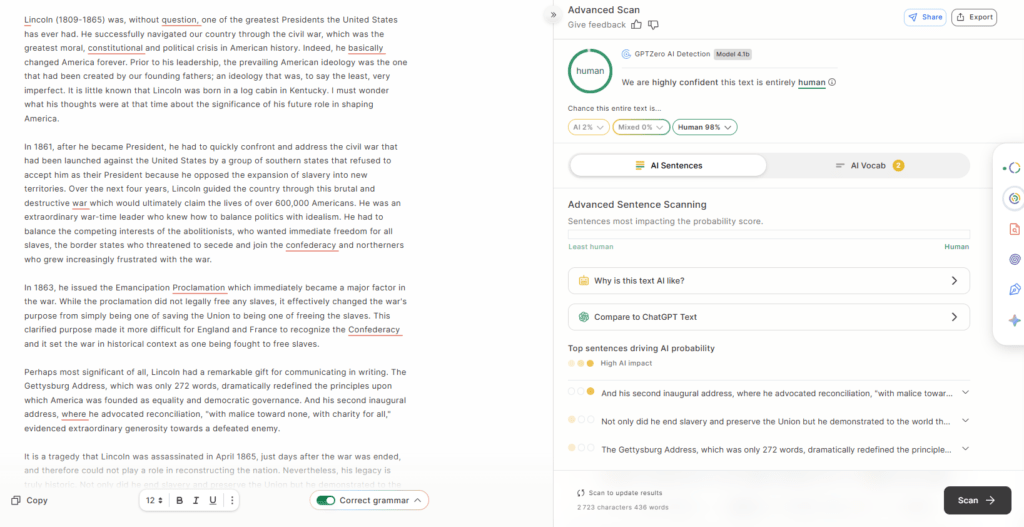
StealthGPT is an AI humanizer that is really good at personalization.
Humanization Technique
1) It adds opinion and emotion.
Instead of staying neutral, it will sometimes insert phrases that sound like personal judgment or reflection. For example: “without question,” “basically changed,” or “I must wonder…” This can make the writing feel more human because people naturally frame explanations with opinion.
2) It makes explanations more conversational.
When a text contains dense, compressed ideas (especially the noun-heavy AI style), StealthGPT tends to unpack them into a sentence that sounds like a person teaching or explaining. It can turn abstract fragments into clearer explanations, which is one of the reasons the output sometimes reads better than what the original model produced.
3) It reshapes the rhythm of the text.
StealthGPT often varies sentence length and introduces a more uneven cadence. That’s one of the cues that helps writing feel less machine-smoothed.
Performance
StealthGPT’s bypass results were mixed, but strong enough to keep it in the top three—especially because the output style can be genuinely usable.
- On the GPT-4 sample, it failed completely: 100% AI.
- On the GPT-4.2 Thinking + Search sample, it was still flagged as AI at 69% AI (so it improved the text somewhat, but not enough to flip the label).
- On the Gemini 3 Pro sample, it produced a good result: 89% human.
- On the Claude Sonnet sample, it performed very well: 98% human.
That places it roughly in the same performance band as Undetectable AI in terms of bypass capability, but with a different profile: it struggled with GPT-style outputs and did better with Gemini and Claude-style writing.
Pricing
StealthGPT is the most expensive tool in this top tier, mainly because it uses weekly billing.
The entry plan is listed around $8 per week, which comes out to roughly $32 per month. That’s significantly higher than tools priced at €15–€20 monthly.
#4 StealthWriter
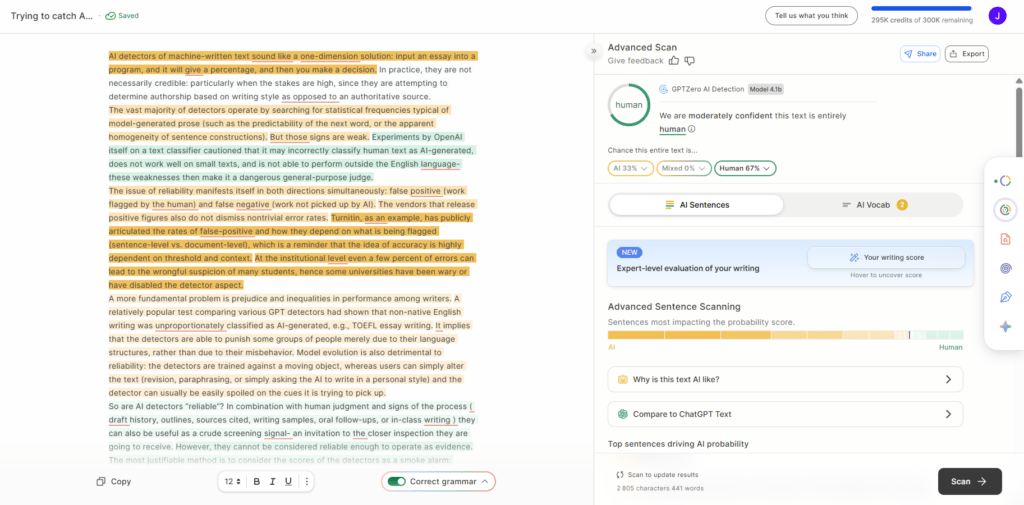
StealthWriter is a an humanizer that lightly rewrite your text without changing the structure too aggressively.
Humanization Technique
1) It swaps out high-signal “AI words” for more ordinary phrasing.
This is one of its strongest patterns. When a text uses phrases like “reliable,” “trustworthy,” “advanced,” “enhanced,” StealthWriter often replaces them with words that feel less like corporate AI copy.
2) It keeps the original structure intact.
This is both a feature and a limitation. The paragraphs usually follow the same order. The logic is preserved. Bullet-point style structures often remain. That means meaning drift is lower than with aggressive humanizers.
3) It makes subtle, local edits rather than global rewrites.
Instead of rewriting an entire paragraph to sound human, it tends to tweak sentence-level phrasing. You’ll see changes like “isn’t just another language model” becoming “is not any other language model”
Performance
In the testing set, StealthWriter produced inconsistent results and overall weaker bypass performance than the top three tools.
- On the GPT-4 sample, it was flagged as 100% AI.
- On the GPT-4.2 Thinking + Search sample, it landed at 67% human, which is its best result in this group and shows that it can sometimes soften the “AI feel” enough to move the needle.
- On the Gemini 3 Pro sample, it was flagged as 100% AI.
- On the Claude Sonnet sample, it was also flagged as 100% AI.
So it achieved one partial win, and three clear failures.
Pricing
StealthWriter sits in the “average” pricing tier for humanizers.
The basic plan is around $20 per month, and it includes a reasonable amount of credits for regular use. That pricing makes sense if the tool saves editing time.
#5 WriteHuman
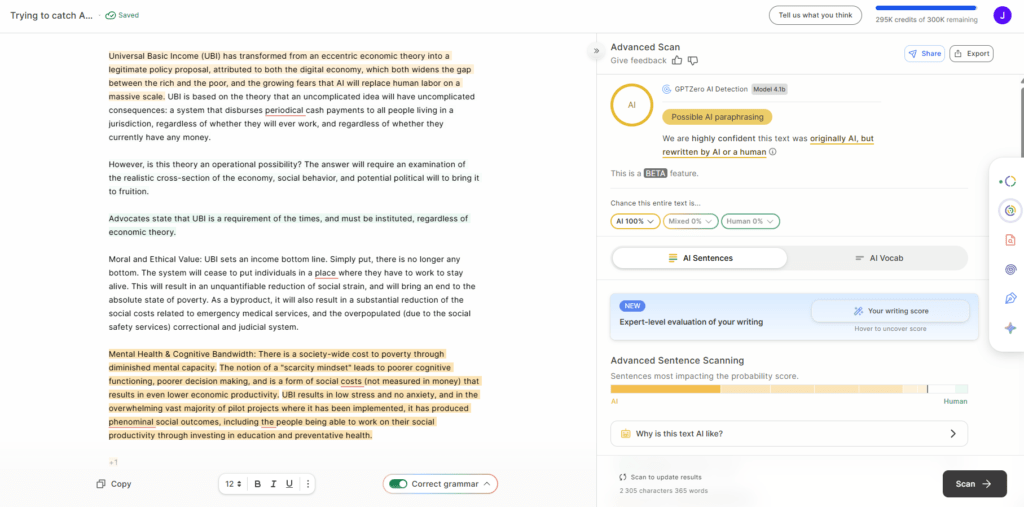
WriteHuman is a humanizer that goes for strong, visible rewriting.
Humanization Technique
1) It shortens the text aggressively.
This is one of its most consistent moves. It will cut clauses, remove supporting sentences, and compress paragraphs into fewer lines. The result is more readable at a glance.
2) It pushes the tone toward plain, direct language.
When a draft is full of formal vocabulary, WriteHuman often flips it into short, confident statements. For example: “There seems to be a very obvious solution…” or “Look at the percentage and move on.”
3) It introduces noisy phrasing and occasional deliberate errors.
This is where WriteHuman becomes unpredictable. It sometimes generates sentences that feel oddly assembled or overly dramatic in a way real editors wouldn’t choose.
It can also introduce typos or strange word choices that look intentional, like a tool trying to “prove” it’s human by being imperfect.
Performance
WriteHuman’s results were mixed and heavily dependent on the sample.
- On the GPT-4 sample, it produced a very strong outcome: 97% human.
That looks impressive, but it came with an important caveat: the rewrite was shortened significantly, and shorter text makes the detector judgment less reliable. - On the GPT-4.2 Thinking + Search sample, it produced an okay result: 70% human.
That suggests it can reduce some AI patterns in more structured writing, but not as consistently as the top tools. - On the Gemini 3 Pro sample, it failed: 100% AI.
- On the Claude sample, it also failed: 100% AI.
So overall, WriteHuman produced two “human-leaning” outputs and two complete failures. That places it behind StealthWriter in reliability, even though it can look stronger on a single run.
The bigger issue is the quality volatility. Even when the score improved, the output introduced weird phrasing and errors
Pricing
WriteHuman is priced on the higher end compared to several alternatives.
The basic plan sits around $27 per month. It also offers a generous free usage option, which makes it easy to test outputs on a variety of drafts before committing.
#6 QuillBot
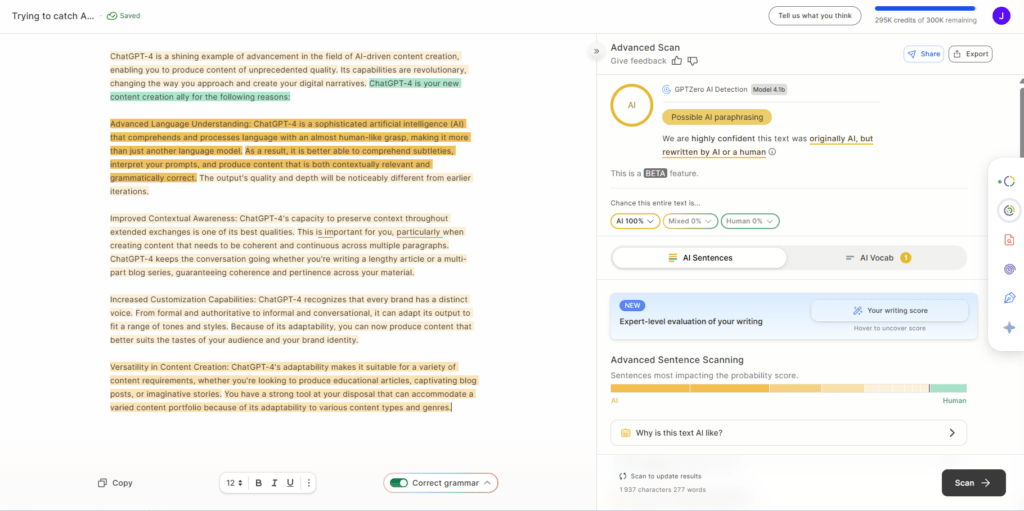
QuillBot is full writing suite that happens to include a rather weak AI Humanizer alongside its other features.
Humanization Technique
1) Synonym-led rewriting.
QuillBot swaps words and phrases to reduce repetition and make sentences flow better. It also encourages manual tweaking by letting you adjust word choices in the output. That can be useful for brand voice work, especially if you want to keep a sentence structure but soften the wording.
2) Low disruption to structure.
Even in stronger modes, QuillBot usually preserves the original outline and paragraph order. That helps when meaning preservation matters. It also means the writing can still feel “AI-shaped” if the original was AI-shaped.
3) Consistency over personality.
Unlike tools that inject a more conversational voice (sometimes adding opinions), QuillBot typically stays neutral. That’s good if you want a safe rewrite. It’s not great if the text needs a real shift in cadence, specificity, and sentence variety.
Performance
QuillBot did not pass a single sample as “Human
- GPT-4 sample: 100% AI
- GPT-4.2 Thinking + Search sample: 79% AI
- Gemini 3 Pro sample: 100% AI
- Claude Sonnet sample: 100% AI
Pricing
QuillBot’s Humanizer is available in two levels: Basic (free) and Advanced (Premium).
Premium pricing, per QuillBot’s official plan page:
- Monthly: $19.95
- Quarterly: $39.95 billed every 3 months (about $13.31/month)
- Annual: $99.95 billed yearly (about $8.33/month)
Why AI Humanizers Are Not Enough
Alright, now, I wanted also to tell you why you shouldn’t rely exclusively on them if you want to generate quality content.
So as you’ve seen, these humamizng tools fundamentally just adds another algorithmic layer on your text.
Which means 3 things :
1. AI Humanizers Only Make Surface-Level Changes
The biggest problem? They don’t actually make your content more human. Instead, they just rewrite sentences at a superficial level.
These tools mostly:
✔️ Swap out words for synonyms.
✔️ Flatten or restructure sentence patterns.
✔️ Remove typical AI markers like repetitive phrasing.
What they don’t do:
❌ Add original insights or unique perspectives.
❌ Improve storytelling, creativity, or depth.
❌ Remove AI’s robotic, unnatural phrasing completely.
At best, these tools make AI text less obvious, but they don’t truly transform it into a high-quality human-like piece.
2. They Don’t Always Pass AI Detectors
Let’s be real—AI detection tools are getting smarter every day. Even the best humanizers on this list failed Originality AI and GPTZero at times, proving that no tool guarantees a perfect bypass.
Even if a tool slips past one AI detector today, future updates could flag it tomorrow.
3. Humanized AI Text Is Often Lower Quality
The more an AI humanizer rewrites your content, the less readable and engaging it becomes. Many tools use excessive sentence flattening, random noise, or word substitutions, making the text feel:
🔹 Dull – Lacks personality, natural flow, or rhythm.
🔹 Confusing – Some tools introduce random words or awkward phrasing.
🔹 Less informative – Humanizers often remove specific details or nuance to sound less AI-like.
If you care about SEO, engagement, or credibility, blindly using an AI humanizer without manual editing will hurt you in the long run.
So What Should You Do Instead?
Here’s the truth: AI humanizers can help—but only as a first step. To truly make AI-generated content high-quality and undetectable, you need to apply manual humanization techniques.
Here’s what actually works:
✔️ Use advanced prompting – Instead of rewriting AI text after, train AI to generate more human-like content from the start with better prompts.
✔️ Manually edit for style and engagement – Rephrase sentences yourself to add variety, personality, and clarity.
✔️ Inject personal insights or unique takes – AI can’t replicate human experience, so adding your own thoughts, opinions, or expertise makes the content feel authentic.
✔️ Break up predictable structures – AI-generated text often follows the same patterns. Rearrange ideas, add sentence variety, and change the tone to sound more human.
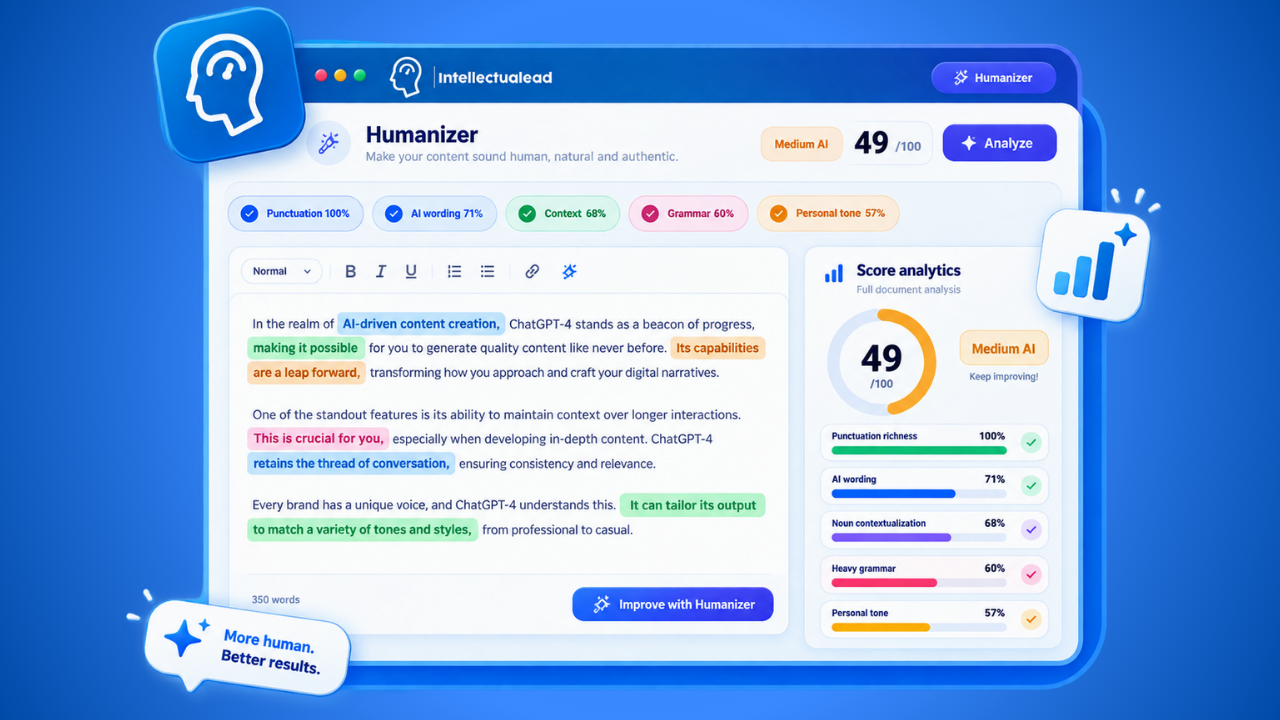
Get Rid of AI Slop
Get the free AI Humanizer and ready-to-use humanizing prompts.
Get the Free Toolkit
Buchert Jean-marc
Confirmed AI content process expert. Through his methods, he has helped his clients generate LLM-based content that fit their editorial standards and audiences expectations.
All Posts