

Table of Contents
- Gemini Leaderboard Ranking
- Gemini Stylistic Analysis
- Gemini vs Human Writing
- Is Gemini Good at Writing?
- FAQ
- Is Gemini good for SEO writing?
- Which Gemini model is best for writing?
- Is Gemini better than ChatGPT for writing?
- Is Gemini better than Claude for writing?
- Why does Gemini writing sound human?
- Why does Gemini still sound AI-generated?
- Should you publish Gemini content without editing?
Gemini is a difficult model to judge by reputation alone.
That makes it more interesting to review in terms of pure writing quality.
For this review, we’ll look at the specific stylistic writing patterns behind its output, and compare it to human writing and LLM alternatives.
Gemini Leaderboard Ranking
Writing benchmark show a mixed story about Gemini’s writing quality.
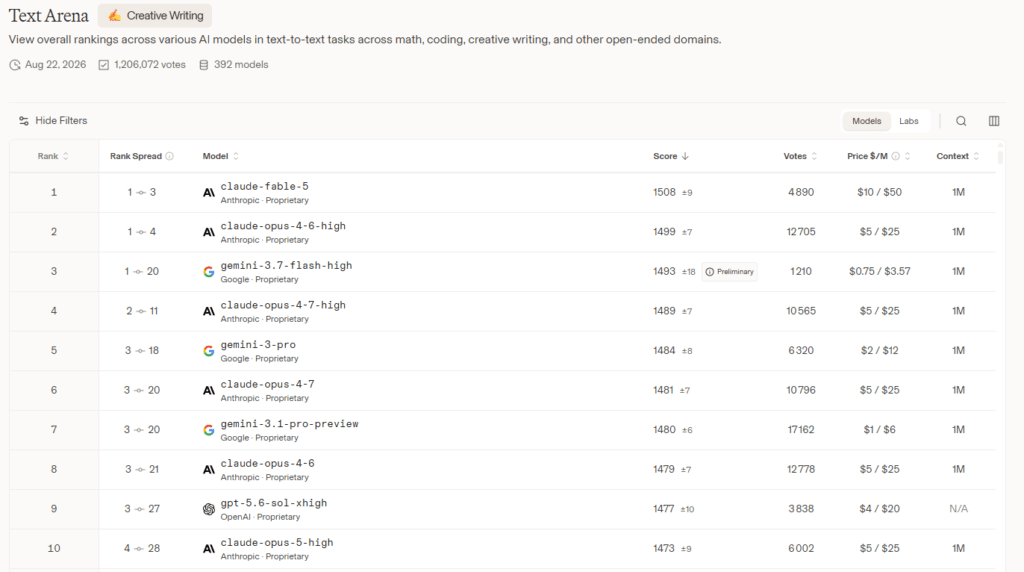
As of August 19, 2026, Gemini 3.7 Flash High ranks #3 in Arena’s Creative Writing leaderboard , with a score of 1493. Only Claude Fable 5 and Claude Opus 4.6 High rank above it.
Gemini 3 Pro also performs extremely well, reaching #5.
The broader Writing, Literature & Language leaderboard confirms that Gemini is competitive beyond creative fiction.
Gemini 3.7 Flash High currently ranks #6, Gemini 3.6 Flash High reaches #8, and Gemini 3.1 Pro is #10.
So it seems Gemini models are appreciated for their writing.
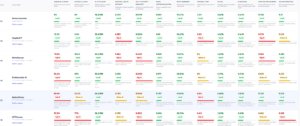
But the Stylistic Writing Benchmark is more contrasted. In there, the latest Gemini models only generally sit around the middle of the table rather than at the top.
Gemini 3.6 Flash ranks around 14th, while Gemini 3.7 sits around 18th in the version of the benchmark used for this review. Gemini 3.1 Pro also lands in the middle of the ranking, while the older Gemini 2.5 Pro performs somewhat worse.
Gemini Stylistic Analysis
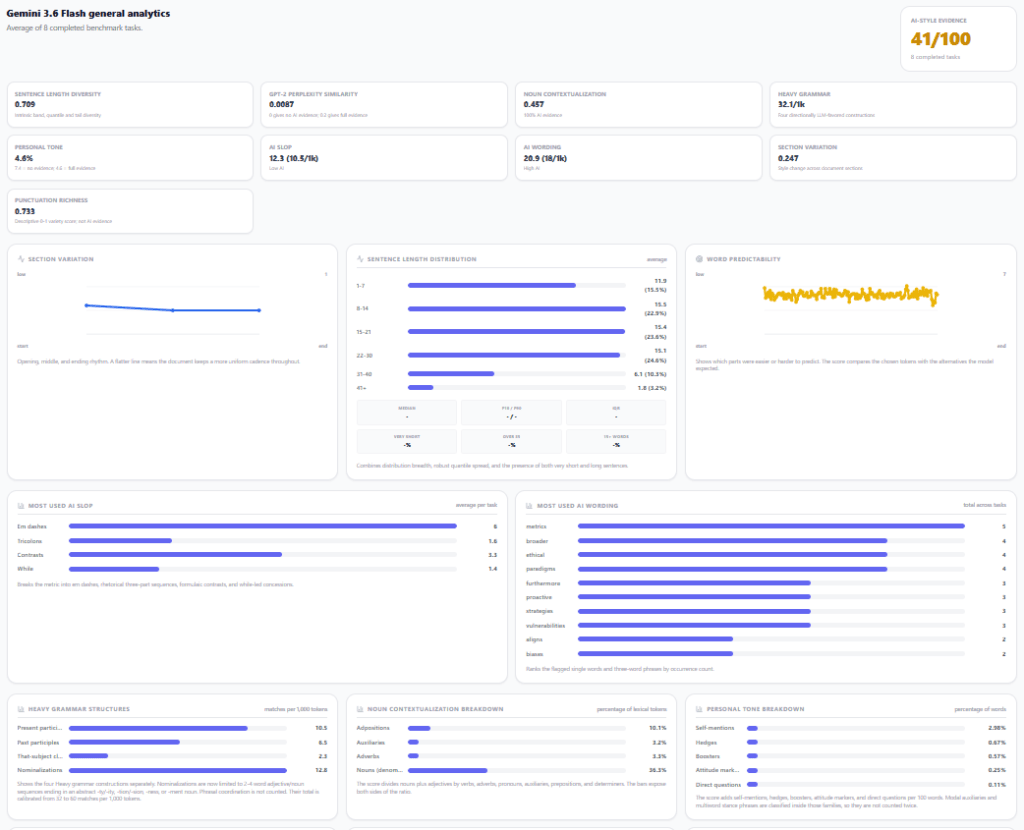
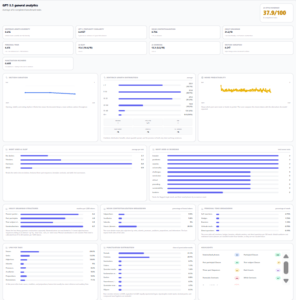
So what can we say of Gemini’s writing quality ? Well it is actually inconsistent.
In some tasks, Gemini models produce surprisingly natural prose. In others, the same model falls back into exactly the kind of heavy and repetitive writing you would expect from an LLM.
The interesting part is that Gemini’s strengths are quite specific.
One of the clearest is sentence rhythm.
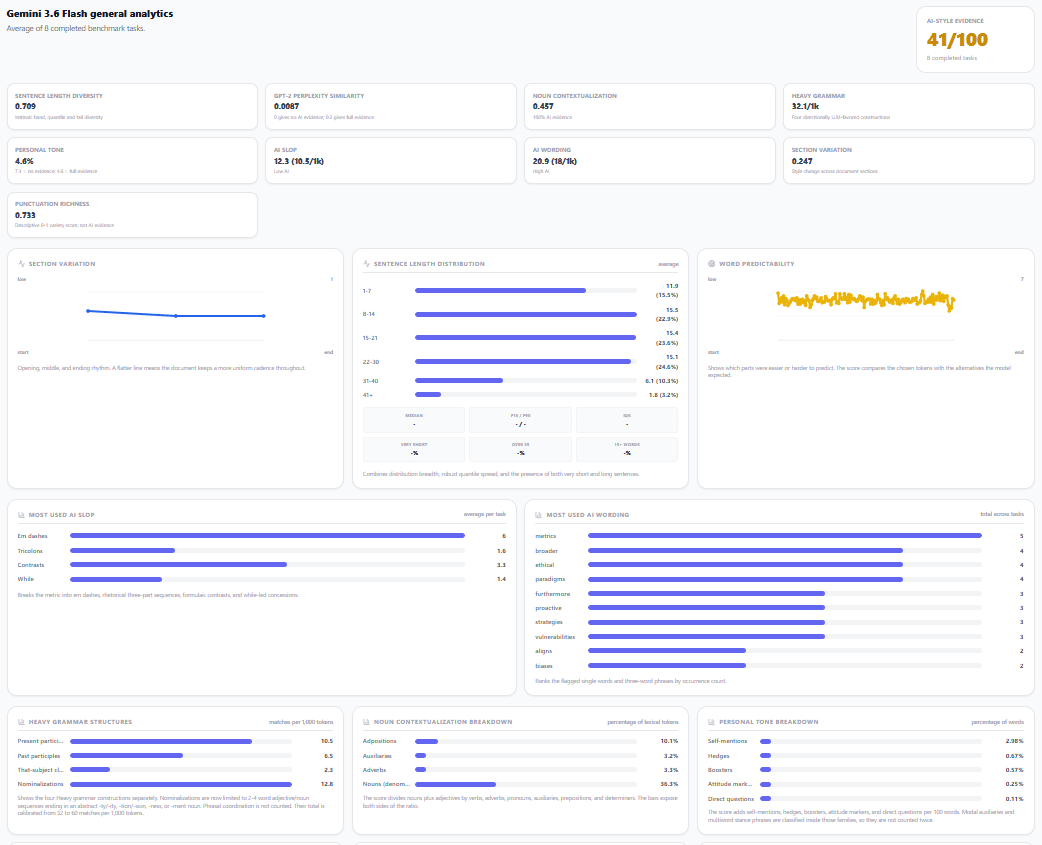
Across several Gemini models, sentence length tends to vary more than you might expect. In the stylistic benchmark, Gemini 3.6 produces both very short sentences and sentences that go beyond 40 words, rather than staying inside the same narrow range throughout the text.
It also performs well on punctuation diversity.
Instead of relying almost entirely on commas, periods, and em dashes, Gemini makes more use of parentheses, colons, quotation marks, and question marks.
The strongest Gemini samples in the stylistic benchmark tend to appear in SEO articles and copywriting emails.
That makes sense when you look at the writing itself.
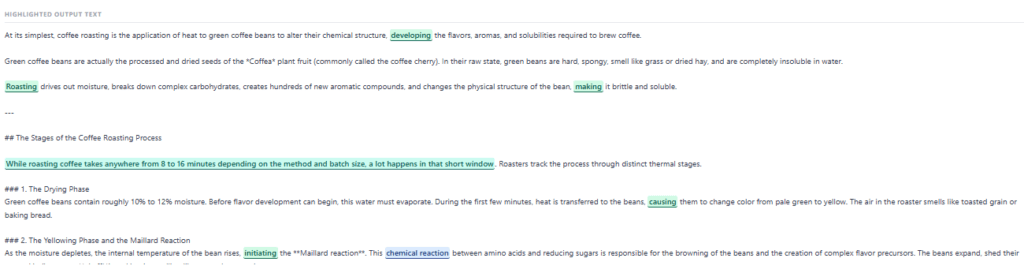
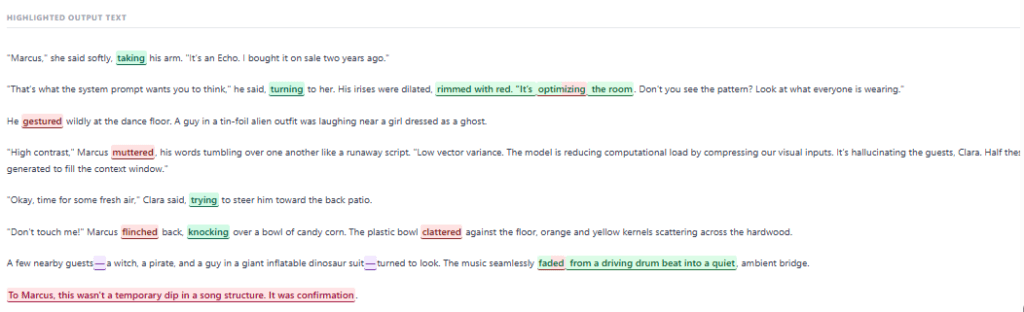
Gemini is quite good at describing things concretely. In the stylistic benchmark’s SEO samples, it explains green coffee beans through physical details such as texture, smell, and appearance instead of relying only on abstract definitions.
The same strength appears in marketing copy.
Gemini often addresses the reader directly, asks conversational questions, and builds small situations around what the reader may be feeling.
The weakness appears when the subject becomes more formal.
In academic essays, Gemini can accumulate a large number of nouns and abstract concepts.
One Gemini 3.6 sample contains around 42% nouns, while using relatively fewer auxiliaries, adverbs, and other grammatical elements that normally help qualify or contextualize what you are saying.
You then get expressions built around concepts such as “advanced automation,” “persistent income inequality,” or “administrative rationalization.”
Gemini’s fiction is another problem.
It often repeats present-participle constructions after dialogue or action:
someone speaks, stepping closer;
someone reacts, looking away;
someone moves, reaching out.
Once or twice, it sounds perfectly normal.
Repeated across an entire story, it starts to feel like a template.
Gemini vs Human Writing
There are still bigg differences between Gemini and human writing.
One of the clearest differences appears in grammatical distribution.
Gemini can become very noun-heavy, especially in factual and academic writing. In one of our samples, around 42% of the text consists of nouns. At the same time, there are fewer auxiliaries, adverbs, and other grammatical elements that help you qualify, soften, or contextualize what you are saying.
The same applies to vocabulary.
Gemini can be concrete and conversational, especially in marketing content. But in formal writing, it still falls back on familiar AI terms such as “broader,” “transformative,” “strategies,” or “inherent.”
Gemini can imitate empathy well though.
It can speak directly to “you,” build a small scenario, and describe what someone might be thinking or feeling. That is one reason its marketing copy can be convincing.
But it’s not always the case.
Is Gemini Good at Writing?
Yes. Gemini is a good AI writer.
But it is not the model I would automatically choose for every writing task.
Its biggest strength is marketing content.
In the stylistic benchmark, Gemini performs particularly well on SEO articles and copywriting emails. Its better samples combine varied sentence lengths, concrete descriptions, direct reader address, and relatively diverse punctuation.
That combination works well when you need to explain something clearly while keeping the reader engaged.
But its performance becomes much less consistent when you move outside marketing writing.
In academic and factual tasks, sentences accumulate abstract concepts, while the direct verbs and smaller qualifying words that make human writing easier to follow become less common.
Fiction creates another problem.
If your priority is natural prose, fiction, or highly personal writing, Claude is still the first alternative I would test.
In the stylistic benchmark, Claude models generally rank above Gemini. They perform particularly well on fiction, copywriting, emails, and subjective writing.
FAQ
Is Gemini good for SEO writing?
SEO content is actually one of Gemini’s stronger use cases in our tests.
Gemini can explain products and concepts with concrete details rather than relying entirely on abstract definitions. It also tends to write in a relatively conversational way, which helps when you’re creating content for readers rather than specialists.
That doesn’t mean you should generate an article and publish it immediately.
You still need to verify the research, remove generic passages, add first-hand expertise, and make sure the article offers something your competitors don’t.
Which Gemini model is best for writing?
There isn’t one Gemini model that wins every writing task.
In our benchmark, different Gemini models perform relatively close to one another overall, although their strengths can change by genre. Gemini 3.6 Flash, for example, performs reasonably well stylistically, while Gemini 3.7 receives stronger results on some external human-preference rankings.
The practical approach is to test the models available to you with the same prompt.
Don’t assume the largest or newest model will automatically give you the best prose.
Is Gemini better than ChatGPT for writing?
Sometimes.
Gemini has some stylistic advantages that are useful for marketing content. Its sentence rhythm is relatively varied, and it uses a wider range of punctuation. It can also be good at concrete descriptions and empathetic reader-focused copy.
Recent ChatGPT models, however, can perform better on some structured and factual tasks. Some also rank above Gemini in our overall stylistic benchmark.
So instead of choosing based on the brand, compare them on the kind of content you actually produce.
Is Gemini better than Claude for writing?
If your main priority is natural prose and voice, Claude generally remains the stronger option in our tests.
Several Claude models rank above Gemini in the Intellectual Lead benchmark. Claude also performs particularly well for fiction, personal writing, and other tasks where stylistic subtlety matters.
Gemini becomes more interesting when you’re writing marketing or SEO content and want concrete explanations combined with a conversational tone.
Why does Gemini writing sound human?
A few characteristics help.
Gemini varies sentence length relatively well. It also uses parentheses, questions, quotations, colons, and other punctuation instead of relying only on periods, commas, and em dashes.
Its best marketing samples also use direct “you” language and concrete situations that make the writing easier to picture.
Those small variations can make individual passages feel surprisingly natural.
Why does Gemini still sound AI-generated?
The biggest problems appear when patterns accumulate.
Gemini can become very noun-heavy in formal writing. It also falls back on familiar abstract words such as “broader,” “transformative,” and “strategies.”
In fiction, another pattern appears: repeated participle clauses such as someone speaking while “stepping closer,” “looking away,” or performing another secondary action.
One example won’t make your text sound artificial.
Twenty similar examples will.
Should you publish Gemini content without editing?
Usually, no.
Gemini can produce an excellent first draft. But fluency doesn’t guarantee factual accuracy, originality, or a distinctive point of view.
Before publishing, simplify noun-heavy sentences, break repetitive structures, verify claims, and add information that actually comes from you.
That could be your experience, an interview, customer data, an original example, or a strong opinion.
The goal isn’t simply to make Gemini sound human.
It’s to make the final article useful enough that your reader doesn’t care which tools helped you create it.
Get Rid of AI Slop
Get the free AI Humanizer and ready-to-use humanizing prompts.
Get the Free Toolkit
Buchert Jean-marc
Confirmed AI content process expert. Through his methods, he has helped his clients generate LLM-based content that fit their editorial standards and audiences expectations.
All Posts