IntellectuaLead
English

ChatGPT for Writing Full Review

Buchert Jean-marc

Buchert Jean-marc

August 26, 2026 • 7 min read
Free Prompts

Free Prompts and Ebook to Humanize Your Text

Download Now

ChatGPT is mostly responsible for many of the writing habits people now associate with bad AI content.

Is it still the case with the latest ChatGPT models ?

By the end of this review, you’ll know how much ChatGPT writing has actually improved, and where its most recognizable AI habits remain.

ChatGPT Leaderboard Ranking

Well, it is safe to say that the latest ChatGPT models are much more competitive writers than their predecessors.

But they still don’t dominate writing benchmarks.

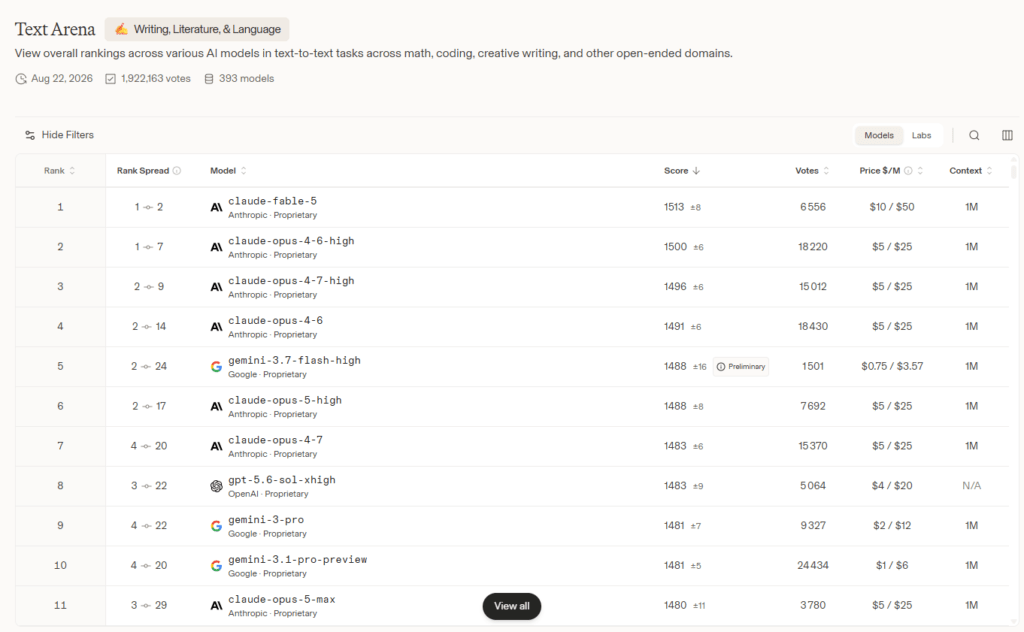
On Arena’s Creative Writing leaderboard, updated August 19, 2026, GPT-5.6 Sol xHigh ranks #9 with a score of 1474.

That puts it comfortably inside the top ten and makes it the highest-ranked recent OpenAI model in the category.

GPT-5.5 Instant ranks #26, GPT-5.5 High is #28, and standard GPT-5.5 sits at #36.

The broader Writing, Literature & Language leaderboard produces a similar result. GPT-5.6 Sol ranks #9, while GPT-5.5 High reaches #17, standard GPT-5.5 #24, and GPT-5.5 Instant #27.

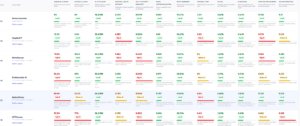
We get also a quite positive ranking for GPT 5,5 on the Stylistic Writing Benchmark. It currently reaches around seventh place, putting it much closer to the strongest writing models we tested.

What this ranking suggests is kind of nuanced: OpenAI has closed much of the writing-quality gap, but ChatGPT still isn’t the model family people consistently prefer most for prose.

ChatGPT Stylistic Analysis

The biggest change in ChatGPT writing is that newer models are clearly less clumsy than the oldest ones.

But the improvement is not linear.

Some problems have become smaller. Others have stayed. And a few have actually become more visible.

One of the clearest improvements is personal tone.

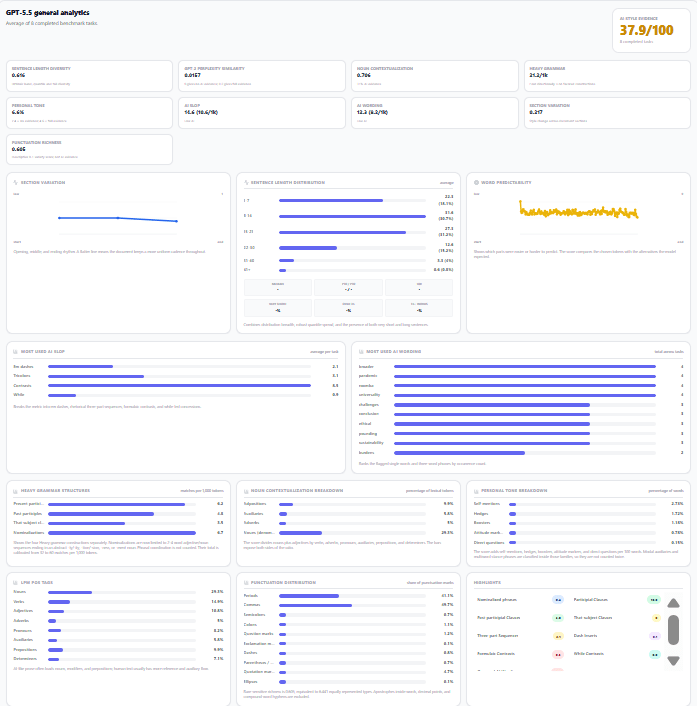
Older ChatGPT models often sounded distant and generic. They relied heavily on abstract nouns and formal phrasing, which made even simple ideas feel dense. Newer models, especially GPT-5.5, use more pronouns, more verbs, and more concrete situations.

The vocabulary has improved too.

Older models repeatedly fell back on words such as “crucial,” “challenges,” “advancement,” and other abstract terms that appeared across very different topics. Newer models use more varied and specific wording.

The latest ChatGPT models also use a wider range of sentence lengths.

But newer models also bring their own problems.

Older models didn’t rely heavily on em dashes, for example. In newer generations, they appear much more frequently.

The same applies to contrast constructions such as:

“It’s not X, but Y.”

You also see more tricolons, balanced phrases, and present-participle clauses.

Also, ChatGPT still tends to accumulate abstract nouns in formal tasks such as academic writing, research, news reporting, and SEO content.

Instead of using direct verbs, it can describe ideas through concepts, conditions, implications, and processes.

That makes the writing feel exhausting to read.

ChatGPT vs Human Writing

The gap between ChatGPT and human writing is a bit smaller than it used to be.

But it is still very visible.

The main difference is not grammar. Newer ChatGPT models can write perfectly correct sentences. They can explain difficult ideas, organize an argument, and produce a clean structure very quickly.

The difference is sentence rythm.

Human writers tend to vary their sentences more naturally.

You might write one short sentence to create emphasis. Then follow it with a longer explanation. Later, you may slow down, change tone, or introduce a more personal example.

ChatGPT is more likely to keep a stable rhythm for too long.

Another important difference is sentence construction.

ChatGPT often describes ideas through abstract nouns.

You get phrases built around concepts such as “implementation,” “viability,” “affordability,” “development,” or “transformation.”

A human writer is more likely to turn those concepts into actions.

ChatGPT also has a strong tendency to make everything feel complete.

You get constructions such as “not X, but Y,” followed by another sentence that neatly explains the contrast.

That structure is useful sometimes.

The problem is repetition.

Is ChatGPT good at writing?

Yes. ChatGPT has become a much better writer.

But whether it’s the best model for you depends heavily on what you’re trying to write.

For factual content, ChatGPT is a strong option. Newer models can explain complex subjects, organize information clearly, rewrite awkward passages, and turn research into a structured first draft.

But Claude is still the strongest alternative for creative writing

On Arena’s Creative Writing leaderboard, Claude Fable 5 currently ranks first. Claude Opus 4.6 High and Claude Opus 4.7 High also sit near the top.

That matches what we found in our own writing benchmark.

Claude tends to perform particularly well when you need fiction, personal writing, copywriting, or prose where rhythm and voice matter. It generally avoids some of the dense, noun-heavy constructions that still appear in ChatGPT output.

FAQ

Which ChatGPT model is best for writing?

Among the recent models we tested, GPT-5.5 performs particularly well on our stylistic benchmark.

Compared with earlier generations, it uses fewer heavy noun constructions, more verbs, more personal language, and less obvious AI wording.

GPT-5.6 is also a strong writer and currently performs better than GPT-5.5 on some human-preference rankings.

That doesn’t mean GPT-5.6 will always produce better prose for your specific task.

If writing quality matters, test the models on the same prompt and source material rather than automatically choosing the newest one.

Is ChatGPT better than Claude for writing?

Not generally.

If your priority is creative writing, personal essays, fiction, or highly conversational prose, Claude currently tends to perform better.

Claude models occupy several of the highest positions on creative-writing leaderboards, and our own benchmark also finds that they tend to produce lighter, more varied prose.

ChatGPT can still be the better choice for structured factual work, research synthesis, or content where organization matters more than literary style.

The useful question isn’t “Which model wins?”

It’s which model works better for the content you’re producing.

Is ChatGPT good for SEO writing?

Yes, but you shouldn’t use it as a one-click article generator.

ChatGPT is good at creating outlines, organizing information, expanding research, and producing a first draft around a clear brief.

The problem appears when you publish that draft without substantial editing.

SEO articles can push ChatGPT toward exactly the style it struggles with most: long sentences, abstract language, repetitive explanations, and predictable section structures.

Use ChatGPT to speed up production.

Then improve the article with original research, expert opinions, real examples, stronger verbs, and more varied sentence rhythms.

Why does ChatGPT writing sound AI-generated?

There isn’t one single “AI word” that gives ChatGPT away.

The effect usually comes from several patterns appearing together.

ChatGPT can overuse abstract nouns, similar sentence lengths, tricolons, em dashes, balanced contrasts, and expressions such as “not X, but Y.”

It can also make every paragraph feel equally structured.

Any one of these patterns is normal in human writing.

The repetition is what makes them noticeable.

How can you make ChatGPT writing sound more human?

Start by editing specific stylistic problems instead of asking ChatGPT to simply “make it human.”

Break up long sentences.

Replace abstract nouns with verbs.

Remove unnecessary transitions.

Vary paragraph and sentence length.

Cut repeated contrast constructions.

Most importantly, add information that actually comes from you: your experience, customer conversations, opinions, examples, and observations.

Those additions matter more than avoiding a list of supposedly forbidden AI words.

Should you publish ChatGPT content without editing?

Usually, no.

A ChatGPT draft can be grammatically excellent while still being generic.

Before publishing, verify its factual claims, remove redundant explanations, simplify heavy passages, and add information readers couldn’t get from another AI-generated article.

The goal isn’t to hide that AI helped you write.

The goal is to make sure the final article is actually worth reading.

Free Prompts

Free Prompts and Ebook to Humanize Your Text

Download Now
Share
Buchert Jean-marc

Buchert Jean-marc

Confirmed AI content process expert. Through his methods, he has helped his clients generate LLM-based content that fit their editorial standards and audiences expectations.

All Posts
Watch more about it

Explore our latest videos

Related Articles

Explore our tips and prompting techniques for quality AI content

Gemini for Writing Full Review:

Is Gemini a good AI model for writing ? Here's a full stylistic analysis.

Claude for Writing Full Review

Ask writers which LLM produces the best prose, and Claude often comes up. But what…

Best LLMs for Writing in 2026 based on Leaderboards

You want to know what are the best LLM for creative, fictional, non-fictional writing ?…