

Table of Contents
- Claude Writing Leaderboard & Benchmark
- Claude Stylistic Analysis
- Claude Writing vs Human Writing
- Is Claude good at writing?
- FAQ
- Is Claude better than ChatGPT for writing?
- Is Claude good for SEO content writing?
- Why does Claude writing sound more human?
- Does Claude still have obvious AI writing patterns?
- Can Claude copy your writing style?
- Should you publish Claude content without editing?
- How do you make Claude writing sound more human?
Ask writers which LLM produces the best prose, and Claude often comes up.
But what exactly makes Claude’s writing better, and is it really that good compared to human writing?
That’s what we’re going to look at here.
Claude Writing Leaderboard & Benchmark
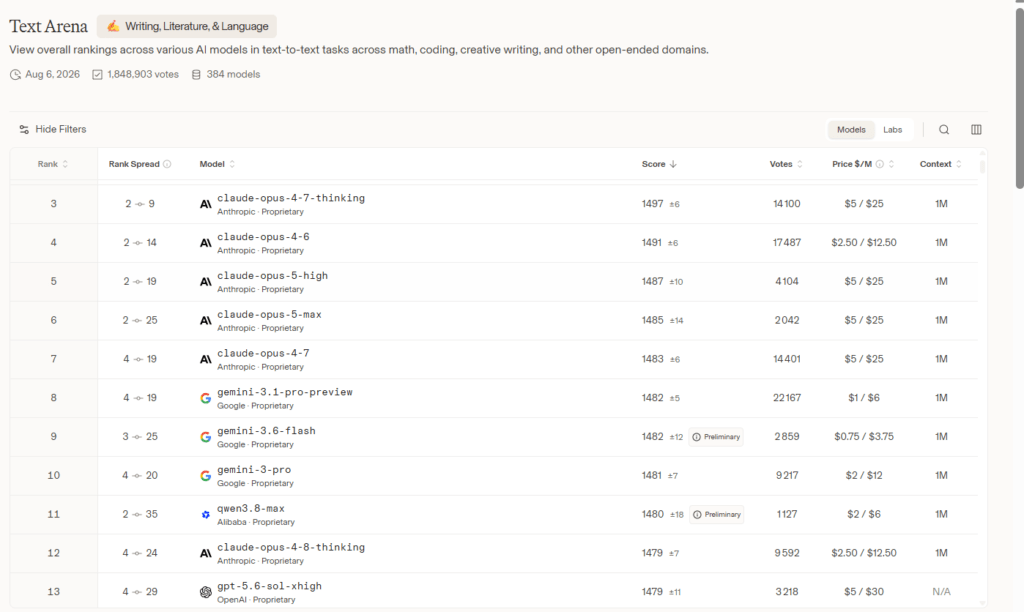
When looking at the leaderboards & benchmarks, Claude seems to dominate human-preference writing rankings
On Arena’s Creative Writing leaderboard, Claude models currently occupy five of the first six positions.
As of July 27, 2026, Claude Fable 5 ranks first, followed by Claude Opus 4.6 Thinking in second place. Claude Opus 5 Max is third, Claude Opus 4.7 Thinking fourth, and the standard Claude Opus 4.7 sixth. Gemini 3 Pro is the only non-Claude model among the first six.
The broader Arena Writing, Literature & Language category shows a similar pattern. Claude Opus 4,7 ranks first there too, followed by Claude Opus 5 and Claude Opus 4.6. They all are at the top.
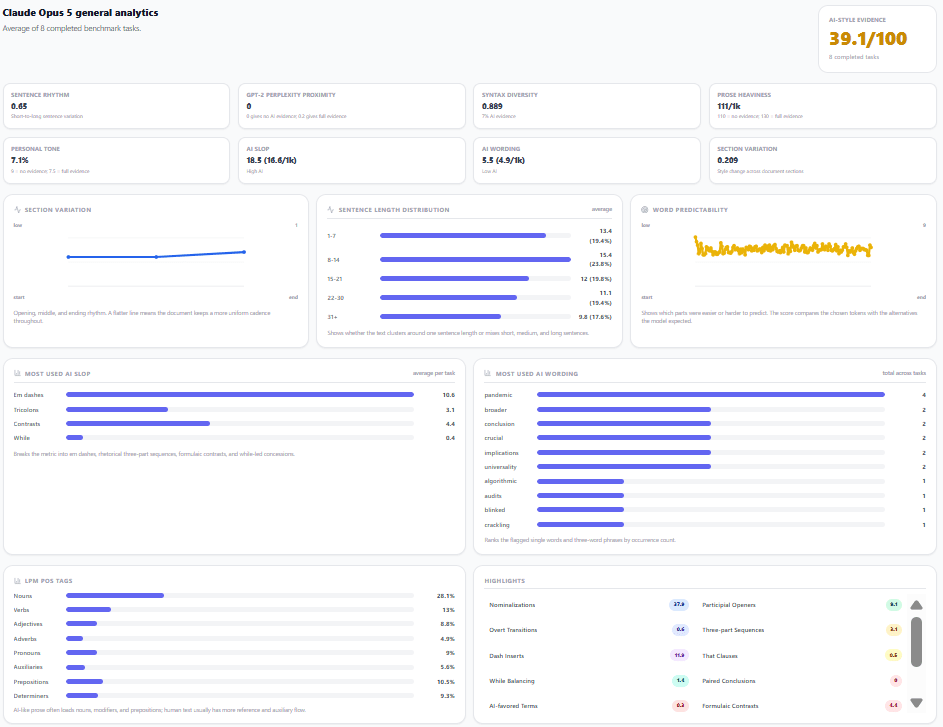
We also looked at our own stylistic writing benchmark.
The benchmark is based on styleometric features that help distinguish human writing from LLM-generated text.
These include sentence rhythm, syntax diversity, the proportion of nouns and verbs, nominalization, personal tone, and stylistic variation between different sections of a text.
And Claude performs remarkably well.
Several Claude models rank toward the top of our leaderboard. Even the weakest-performing Claude model in the test sits around 11th place out of roughly 25 models. By comparison, most of the ChatGPT models we tested appear in the second half of the ranking.
This doesn’t necessarily mean Claude produces the “best” writing in every situation. We’ll see later that its performance changes quite a lot depending on what you ask it to write.
Claude Stylistic Analysis
What are the stylistic patterns behind Claude’s strongest results ?
The first thing that stands out is sentence rhythm.
AI writing often feels repetitive because sentences keep falling into a similar length. You get one medium-length sentence, then another, then another. Nothing is technically wrong, but after a few paragraphs, the rhythm becomes predictable.
Claude handles this better than many models.
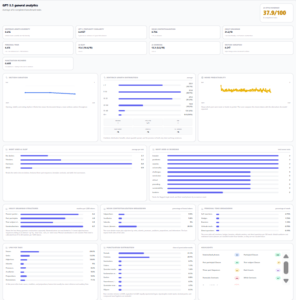
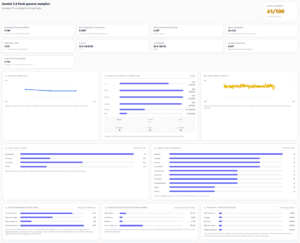
Our stylistic leaderboard show for example that Claude Opus 4.6 mixes short sentences with much longer ones instead of maintaining the same pace throughout the text. That variation makes the prose feel closer to a conversation and less like a model assembling equally sized blocks of information.
Another important difference is what we call prose heaviness.
LLMs have a tendency to rely on abstract nouns and nominalizations. Instead of writing:
“People decided to change the strategy.”
You might get:
“The implementation of a strategic transformation became necessary.”
The second sentence sounds more formal, but it is also heavier and harder to read.
Claude’s strongest writing samples avoid this problem surprisingly well. In the copywriting example from our benchmark, nouns represent around 20% of the text, while Claude makes greater use of verbs and pronouns.
Pronouns also help Claude address people more naturally. Instead of constantly talking about “customers,” “individuals,” or “users,” Claude can move between “you,” “we,” “she,” and “they.”
This doesn’t mean Claude writing hasn’t flaws.
Its style becomes noticeably heavier when you ask for more formal content. In our tests, Claude performed worse on academic essays, research papers, SEO articles, and some biography tasks. It relied on longer sentences, more abstract nouns, and a more rigid rhythm.
And even Claude’s best samples still contain patterns you probably recognize from AI writing.
You can find em dashes, groups of three, balanced “not X, but Y” constructions, and dramatic phrases such as “Here’s the truth nobody wants to admit.”
Claude Writing vs Human Writing
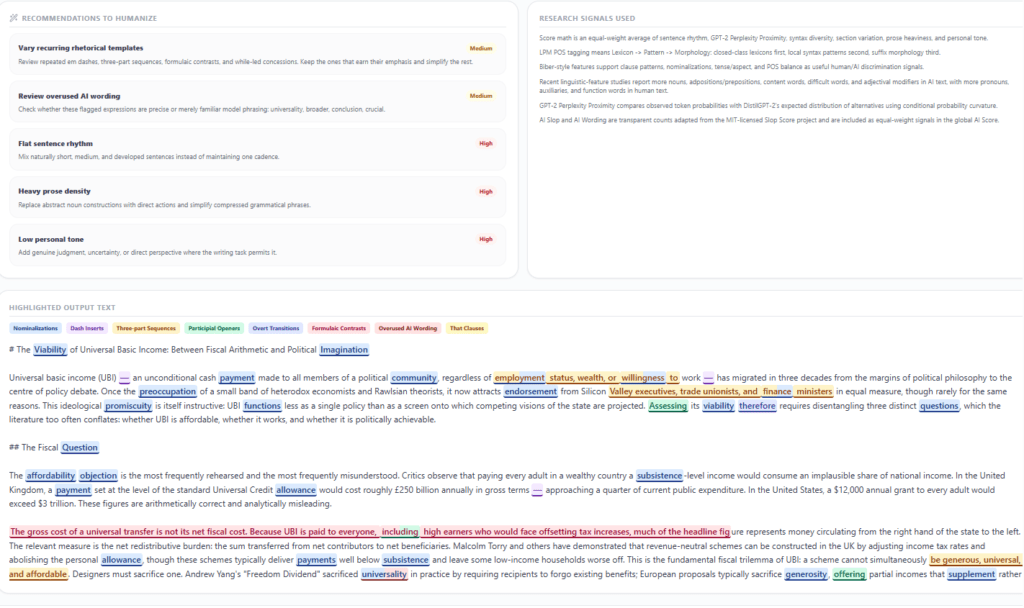
Claude can get surprisingly close to human writing on the surface.
It can vary sentence length. It can use pronouns naturally. It can avoid some of the noun-heavy structures that make other LLMs sound stiff. In fiction and copywriting especially, its syntax can be diverse enough that the text doesn’t immediately feel machine-generated.
But when you compare Claude with actual human writing across several tasks, some drastic differences remain.
I mean of course, it’s still a LLM.
One of the biggest is unpredictability.
Claude is more likely to settle into a pattern.
You can see this clearly in the biography test from our benchmark. Claude Opus 4.6 produces several long sentences of similar length. The style also changes very little between the beginning and the end of the text. The human biography has more short and medium-length sentences and shows clearer variation between sections.
This difference becomes even clearer in more formal writing.
In the academic essay test, Claude relies heavily on nouns and abstract concepts. The human baseline is lighter, with fewer dense nominalizations and a more balanced relationship between nouns and verbs.
And even Claude’s best samples still contain patterns you probably recognize from AI writing.
You can find em dashes, groups of three, balanced “not X, but Y” constructions, and dramatic phrases such as “Here’s the truth nobody wants to admit.”
Is Claude good at writing?
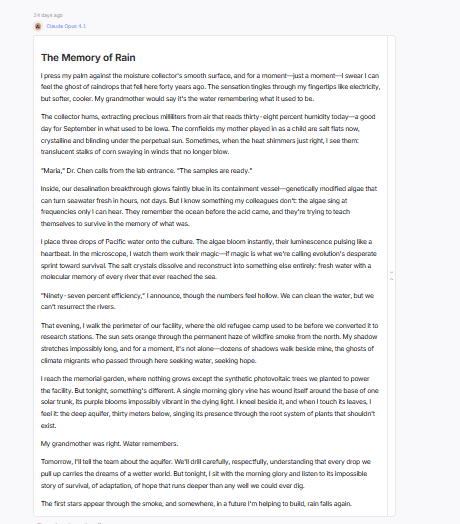
Yes. Claude is one of the strongest AI models you can use for writing right now.
But Claude is not equally good at every type of writing.
In our benchmark, its strongest results appear in tasks such as copywriting, emails, fiction, and personal writing. These are the areas where its sentence rhythm, use of pronouns, syntax diversity, and lighter prose work particularly well.
If you’re writing a sales email, a personal essay, or a piece of narrative content, Claude can give you a very strong first draft.
The result is different when you move toward more structured and factual content.
For SEO articles, academic essays, research papers, and some biographies, Claude tends to become more formal and repetitive. Sentences get longer. Abstract nouns accumulate. The rhythm becomes less varied.
In this kind of genre, Gemini or Chinese models like Kimi can be a good alternative.
FAQ
Is Claude better than ChatGPT for writing?
For pure writing quality, our benchmark generally favors Claude models over the ChatGPT models we tested. Several Claude models rank near the top, while most ChatGPT models appear lower in our stylistic ranking.
But you shouldn’t turn that result into a universal rule.
The better model depends on what you’re writing, how you prompt it, and how much editing you plan to do afterward. Claude’s advantage is particularly noticeable when you want a lighter, more personal style.
Is Claude good for SEO content writing?
Claude can produce a solid SEO draft, but this isn’t where it performs best stylistically.
In our tests, Claude becomes heavier on structured tasks such as SEO articles, research papers, and academic essays. You see more long sentences, abstract nouns, and repetitive sentence rhythms.
So if you use Claude for SEO content, don’t stop after generation. Simplify dense passages, vary the rhythm, verify claims, and add information your competitors aren’t already repeating.
Why does Claude writing sound more human?
A large part of it comes from variation.
Claude’s stronger samples mix short and long sentences, use verbs instead of relying too heavily on abstract nouns, and move naturally between pronouns such as “you,” “we,” and “she.”
Those small stylistic choices make the text feel more like someone speaking to you rather than a system delivering information.
Does Claude still have obvious AI writing patterns?
Yes.
Even some of Claude’s strongest samples contain familiar patterns such as em dashes, tricolons, balanced “not X, but Y” sentences, clichés, and overly polished rhetorical transitions.
That’s why simply switching from another LLM to Claude won’t automatically solve your AI-content-quality problem.
Can Claude copy your writing style?
Claude can imitate many surface characteristics of your writing if you provide enough examples and clear instructions.
It can reproduce sentence length, vocabulary preferences, level of formality, and common structures.
What it cannot reproduce automatically is the experience behind your writing. Your opinions, observations, customer knowledge, and personal judgment still have to come from you.
Should you publish Claude content without editing?
Usually, no.
Claude can give you a polished first draft, but polished doesn’t necessarily mean useful or original. You should still check factual accuracy, remove generic passages, improve examples, and make sure the argument reflects what you actually want to say.
How do you make Claude writing sound more human?
Don’t just prompt Claude to “sound human.”
Edit specific problems instead.
Vary sentence lengths. Replace abstract nouns with verbs. Remove repetitive structures. Cut unnecessary transitions. Add concrete examples. And most importantly, insert your own experience and point of view.
That’s what turns a good Claude draft into content that actually sounds like it belongs to you.

Get Rid of AI Slop
Get the free AI Humanizer and ready-to-use humanizing prompts.
Get the Free Toolkit
Buchert Jean-marc
Confirmed AI content process expert. Through his methods, he has helped his clients generate LLM-based content that fit their editorial standards and audiences expectations.
All Posts