

Table of Contents
- How to use these prompts
- Step 1: Persona & Style Reference
- Step 2: Stylistic Alteration
- Step 3: Transition Words
- Step 4: Colloquialism
- Step 5: Hedging
- Step 6: Word Adding
- Step 7: Adversarial Substitution
- Step 8: Spelling Errors
- Step 9: Burstiness
- Best 4 Edits to 100% Bypass AI Detectors
- Edit 1: Remove AI Stylistic and Grammatical Patterns
- Edit 2: Adjust Perplexity (Vocabulary & Probability Distribution)
- Edit 3: Sentence and Paragraph Burstiness
- Edit 4: Infuse a Personal Touch, Opinions, and Hedging
- The Ultimate Combination
With advanced AI detectors like GPT-Zero and Pangram, bypassing detectors has genuinely gotten harder.
So hard that I spent weeks searching the latest prompting & editing techniques to find a solution.
And thankfully, I found a sequence of 9 prompts & 4 eduts that will significantly reduce the chances of your text being flagged as AI.
How to use these prompts
Before showing you these nine prompts, I’ll first do a quick introduction on how they work. These prompts are designed as a sequence. Each addresses a specific linguistic or structural pattern that AI detectors look for, based on academic literature and my own extensive prompting experiments.
You can access and inject all of these prompts easily using the Intellectual Lead prompting manager. With the Chrome extension or web app, you can apply them right away into ChatGPT, Gemini, or Claude with a single click, saving you the time of copying and pasting each one manually.
We’re going to apply these nine prompts step-by-step. Let’s break down what each prompt does to make your AI-generated text sound undeniably human.
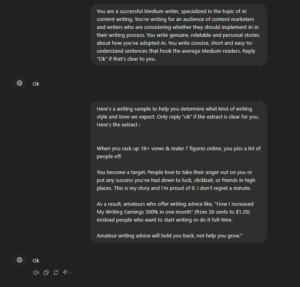
Step 1: Persona & Style Reference
This technique is ingenious. We want to give human patterns to the AI’s context so it’s more likely to get rid of its default AI patterns.
By copy-pasting a long sample of conversational human writing (like a video transcript), we instruct the AI to rewrite our text taking inspiration from this natural style.
Pro Tip: Use a reasoning model for this step. It will think more about the process, resulting in fewer AI patterns.
Base yourself on the natural & spontaneous structure and style of this extract " Well, let's start by briefly presenting the tool and see how it works. So Undetectable AI is actually a tool with many features. The main feature being the AI humanizer, but also the AI detectors. Both of these tools actually work together. You can use the AI detector to identify a piece of text as an AI or not as a human. And then Undetectable also rely on this tool to fine-tune your text to make it less detectable with its most well-known AI humanizer. This AI humanizer is actually the most popular tool you can find online. Many people are already using it, especially students and people at school. It's actually a very easy to use tool, very straightforward. You have just to go on the page. For example, here I'm going to put GPT-4 generated text. So it takes me a lot of AI patterns. and then click humanize. And as you can see here, you get as an output text that is reformulated, rewritten so that it bypasses AI detector and it sounds more human. There's multiple models. There's the stealth model, but also the undetectable model, which is better. And as you can see here, then you just can copy past it and you have already some changes in your text that will make it look more human. I'm going to talk after more deeply how this algorithm works to humanize your text very very specific details especially in terms of the style the rewriting but for now i'm just going to present the other tools of course. Also there's the ai detector so just put the text and check if it's ai or not and as you can see it says more human so i put the text that i just humanized. So as you can see yeah all of them work together. But i have to say though already that the AI detector here in undetectable AI is definitely not the best on the market. You can find better ones, more accurate in how they detect AI content. I actually already made a whole video and article about these AI detectors, especially studying the academic benchmark and studies, the objective studies, comparing the best tools on the market. And as you can see from this ranking, there's no undetectable AI because it's definitely not the best. It has a really low accuracy, and robustness compared to the other tools like pangram already, like the ai gpt zero that you might already know. About it, has also a really high false positive rate, so it might say that it's ai even though it's not it's a human writer that did it. So i let you check this article here. Since 2023, they've also expanded their feature and added more features, because how popular they were so they said okay let's maybe add other features that will help students. Like for example AI job applier. You also have the AI image detector, AI audio detector and all other kinds of AI writing tool like writing starter locator, AI essay writer, AI chatbot, human typer. All of these tools are interesting but yeah definitely the most interesting tool that I use is the AI humanizer and yeah I have to say it's one of the best AI humanizers on the market. I also did a study comparing the best AI humanizer and a video also about it. I'll let you check this video also. And in this video, actually undetectable AI ranked as a close second to GPT-Human, which I found the best in my own experiment with some texts. And I'm going to show you the result of this experiment, analyze how undetectable AI humanizes this text and make sure that it bypasses AI detectors. So let's go. All right, my experiment to analyze undetectable AI humanizing was based on four texts that have been generated by original LLMs like GPT-4, so a very legacy old LLM, the GPT-4.2 which is one of the latest, Gemini 3 Pro and Cloud Sonnet 4.5. And then I put all of these texts into undetectable AI and let's see the result. So I put this result, this humanized text by undetectable in GPT-0 which is also one of the best AI detectors. And what's good with GPT-Zero is that it shows you the sequences on the text that are most likely to be AI. And so you can see you have a guess a view of what a humanizer does with a text. So let's talk first about how Undetectable humanized a very old LLM output which is GPT-4. So yeah, GPT-4 output as you can see was full of AI patterns. You could tell from the start it's written by an AI. So there's like bullet points with very formal nouns and very abstract advanced language understanding, enhance contextual awareness. You also have all the drops. of AI writing, so in the realm of AI driven content creation. So as usual it's very hyperbolic adjectives. A stanza has become a progress. So very much likely words you can find in an AI text. The structure is also very repetitive and predictable. So you have the very well known it isn't but it is. Also the balance argument whether you're or all the paragraphs also are in the same length somehow. So you have like three sentences, you have three sentences, and you have three sentences. So very predictable also in it in this way. And then you put this text in undetectable AI and what you get is something a bit less AI but still very much AI. Because yeah it's difficult to change some deep AI patterns especially with like legacy LMA models, very old all the other models. So you get, yeah, more AI, definitely 69% AI. but still a bit of human in there. As you can see here it's more human in this part. And you can see already where it does its magic." To rewrite the following text :
Step 2: Stylistic Alteration
This prompt is sophisticated because it relies on academic literature regarding the differences between AI and human writing. LLMs overuse nominalizations (abstract nouns), “that-clauses” as subjects, and participle clauses.
This prompt minimizes those patterns and forces the AI to favor features humans use more often, like active verbs, concessive subordinators (“although”), and WH-relative clauses.
Explicitly minimize nominalizations (using active verbs instead of derived nouns), past participial postnominal clauses (e.g., The solution produced by this process), That-clauses as subject (e.g., the dog that bit me) and sentence relatives (e.g., Bob likes fried mangoes, which is the most disgusting thing I’ve ever heard of.) in the text. Instead, rather favour Concessive subordinators (e.g., though, although) and Wh-relative clauses functioning as objects (e.g., the man who Sally likes) in the following text :
Step 3: Transition Words
A simpler prompt, but highly effective. AI doesn’t like to add a wide variety of transition words naturally.
By forcing it to add transition words between sentences without changing the rest of the text, you break its default patterns and make the writing sound casually conversational.
Add natural transition words between each sentences of this text to make it flow like spontaneous human writing. For example, "on one hand", "although", "however", "even though", "At the same time", "As a result", "Indeed", etc..
Step 4: Colloquialism
This additive prompt makes the text sound more casual, like normal talking.
By adding digressions, contractions, rhetorical questions, and small talk contextually, you bypass strict AI structures without losing the original meaning.
Add in this text personal, opinionated, or anecdotal digression, specific contractions, some rethorical questions and small talk sequences. Don't change the rest of the text, just add these additional elements. Here's the text :
Step 5: Hedging
AI usually makes assertions without adding nuance. Human writing naturally incorporates hedging elements to express intellectual caution.
Asking the AI to include words like “might,” “may,” “can,” “probably,” or “potentially” adds unpredictability to the writing.
Add some hedging language to this text to express intellectual caution, such as modal verbs and qualifiers. For example, favor "might", "may", "can", "probably", "potentially"
Step 6: Word Adding
Based on academic studies analyzing words least used by LLMs, this prompt forces the AI to insert emotional, controversial, and interjection words (like “shouted,” “hate,” “oh”).
It adds noise to the text, which you might need to lightly edit later, but it strongly helps bypass detection.
Specifically add some of these words contextually in the text: ll, looks, mouth, oh, wo, says, pretty, couple, seems, anyway, fuck, hell, stuff, damn, office, ca, shit, paper, women, bastard, gets, picture, shouted, fingers, shoulder, definitely, ate, ah, guess, please, d, hate, knows, orange, sit, god, cry, torture, fault, die, na, edit, click, direction, deserve, relationship, breathing, normally, honest, flesh, son, jacket, eight, suppose, send, chair, cabinet, y, till, smoke, pile, armor, reaching, inevitable, starving, kicked, fed, hated, realise, shouting, chin, somewhere, hanging, kinda, scratch, gon, muster, nope, alcohol, bloody, blood, roll, slammed, dollars, yearold, decent, lights, accent, cheek, sits, bathroom, gotten, deserved, asleep, tear, writing, uh, literally, hall, obviously deep, soul, seemed, slightly, perhaps, shit, powers, bastard, rise, ago, warm, address, count, swear, absolutely, further, thousand, though, impact, torture, odd, discovered, whenever, frozen, million, heading, normally, existence, sea, carry, appeared, necessary, battle, reality, flesh, definitely, century, similar, entered, jacket, eight, seven, data, cabinet, y, rushing, till, armor, dull, reaching, relief, inevitable, starving, clear, kicked, actual, brings, realise, space, souls, instant, blanket, kinda, smart, slow, muster, tightly, placed, causing, hands, somehow, threat, slammed, progress, landed, pressed, surely, stars, gold, silly, wet, bodies, gun, seeking, uh, advanced, literally, humanity, hundred, faster, advance, officers, pure, masters, leader, disgusting, intelligence, breath, particular, master. Don't alter the text otherwise, just implement these words in the following text :
Step 7: Adversarial Substitution
We want to substitute words with less predictable counterparts in statistical terms. This increases the “perplexity” of the text (the non-likelihood of the next token).
By completely rephrasing with less likely words, we broaden the probability curve.
You want to perform word substitutions on most of the words of this extract. Choose alternative wording that favour way less predictable words in statistical terms while not changing the sentence structure at all. Here's the text to rewrite :
Step 8: Spelling Errors
This is possibly the most powerful prompt in the sequence, especially against rigorous detectors like Originality AI.
Deliberately adding minor spelling errors introduces highly unlikely tokens, skyrocketing the text’s perplexity score. While you should use this cautiously for academic submissions, it is incredibly effective.
Rewrite the following text passage with spelling errors. However, the errors should not be so extreme that the text becomes incomprehensible. Aim for errors that are commonly seen in writing by individuals who have a good grasp of the English language. This is the text:
Step 9: Burstiness
This prompt focuses on “burstiness” — making the structure of sentences and paragraphs unpredictable. AI detectors look for uniform paragraph lengths.
This diversifies the text, mixing short sentences with long ones, and creating varied paragraph lengths.
Rewrite the following passage by varying sentence length to create a more dynamic and engaging text. Use a mix of short, medium, and long sentences to achieve this effect. Adjust paragraphs so that these are also of a different length. While varying sentence length, you might also ensure that the text remains coherent and well structured
Best 4 Edits to 100% Bypass AI Detectors
If you want a 100% chance to bypass AI detection, the ultimate step is to apply manual editing techniques yourself. By stepping in and editing the text directly, you can break the machine patterns that trigger detectors.
Edit 1: Remove AI Stylistic and Grammatical Patterns
Linguistic research shows that Large Language Models (LLMs) like GPT-4o and LLaMA overuse specific grammatical and stylistic features compared to human writers.
By systematically removing these AI patterns, you make the text look natural to human readers and less suspicious to detection algorithms.
- Ditch the Em-Dashes (—): AI overuses em-dashes to glue clauses together. Replace them with colons, parentheses, or split the sentences.
- Break Up Tricolons (Groups of Three): LLMs love list-like rhythms in groups of three (e.g., “flexibility, affordability, ease of use” or “advanced sensors, force-limiting technology, and intelligent software”). Break these structures up by using adjectives or deleting/adding elements to vary the rhythm.
- Eliminate Nominalization: AI overuses abstract, derived nouns like “flexibility”, “affordability”, or “implementation”. Replace these with active verbs or descriptive adjectives. For example, instead of saying “as businesses look to increase productivity and efficiency,” change the structure to focus on direct actions.
- Remove Present Participle Clauses: AI overuses clauses starting with “-ing” (e.g., “allowing employees to focus on…”). Replace these with relative clauses (e.g., “which allows employees…”).
- Avoid Balanced Formulas: Simplify formulaic contrasts like “not only… but also” or “it is not to [X] but to [Y]”. Keep the arguments spontaneous and asymmetrical.
Live Example (Before & After Style/Grammar Edit):
Original AI Text: “Collaborative robots offer flexibility, affordability, and ease of use—vital components of the modern workplace—allowing employees to focus on creative tasks.”
Edited Human Style: “Collaborative robots are increasingly implemented in business processes because they are flexible and represent good value for money. These systems handle repetitive and demanding tasks, which allows employees to focus on other areas.”
Edit 2: Adjust Perplexity (Vocabulary & Probability Distribution)
AI detectors analyze the probability distribution of each word (perplexity). The more predictable your word choices are in the context of the sentence, the higher the AI detection score will be. Humans naturally use more surprising, specific, and sometimes simpler vocabulary.
Swap out high-probability AI clichés for concrete or conversational terms:
- Replace “innovation” with “invention”.
- Replace “operate” or “utilize” with “work” or “use”.
- Replace “transforming” or “revolutionizing” with “disrupting”.
- Replace “cages” with “installations”.
- Replace “affordable” with “good value for money”.
- Replace “automated system” with “what we build” or “platform”.
- Replace “automotive” with “car manufacturing”.
- Replace “build” with “manufacture”.
Live Example (Before & After Perplexity Edit):
Original AI Text: “In recent years, innovative collaborative robots have transformed the automotive industry by operating without traditional safety cages.”
Edited Human Style: “Recently, collaborative robots have appeared as a new invention disrupting car manufacturing by working without safety installations.”
Edit 3: Sentence and Paragraph Burstiness
Burstiness describes the variation in sentence length and paragraph structure. LLMs tend to generate sentences that are roughly the same length (typically averaging 20 words) and keep paragraph structures highly uniform (e.g., exactly three sentences per paragraph).
Human writing is “bursty” : it features sudden shifts from extremely long, complex sentences to very short, punchy ones.
To implement burstiness in your text:
- Combine and Extend: Build a very long sentence containing multiple clauses, commas, and contrasting ideas.
- Inject Punchy Statements: Follow your long sentences with a short, three- or four-word sentence.
- Vary Paragraph Lengths: Break up uniform blocks. Mix single-sentence paragraphs, bullet points, and longer paragraphs.
Live Example (Before & After Burstiness Edit):
Original AI Text (Uniform 20-word sentences): “Traditional industrial robots are very large and must operate behind safety fences. Collaborative robots are designed to work directly alongside humans. They are lightweight and easy to reprogram for different tasks.”
Edited Human Style (Bursty): “Whereas normal industrial robots work behind safety cages, collaborative robots are specifically made to work alongside people. So cobots are flexible. Good value for money. They are disrupting industries like manufacturing, logistics, and healthcare.”
Edit 4: Infuse a Personal Touch, Opinions, and Hedging
LLMs are trained to remain neutral, objective, and cautious. Human writers, however, have strong opinions, share anecdotal stories, and use conversational elements.
Adding these components makes the text instantly sound like a personal essay or journalistic piece rather than a dry database export.
- Use Adverbs: AI rarely uses emphatic adverbs naturally. Inject words like “definitely” (e.g., “have definitely appeared”) to show conviction.
- Add Conversational Hooks & Rhetorical Questions: Use phrases like “You might know that…” or ask questions like “What is the definition of a robot? Well…” to engage readers directly.
- Share Personal Views & Stance: Take a definitive point of view instead of trying to perfectly balance every argument. Phrases like “bringing a lot of relief to factory owners” or “no fear of displacement with cobots” give the piece character.
- Intellectual Hedging: Use modal verbs and qualifiers (e.g., “might”, “may”, “can”, “probably”, “potentially”) to express intellectual caution when making claims, mirroring how experts write.
Live Example (Before & After Personal Touch Edit):
Original AI Text: “Collaborative robots do not replace human workers. They handle repetitive physical tasks, which allows employees to perform higher-value roles.”
Edited Human Style: “As you might recall, traditional robots are usually large and unsafe. Cobots are the contrary. They are manufactured to handle repetitive, demanding tasks, so there is no fear of displacement here. In fact, making automation easier for smaller plants brings a lot of relief to factory owners.”
The Ultimate Combination
For the best results, apply all four manual techniques at the same time. If you want to make this process even faster, try providing the LLM with your own draft ideas, outlines, or a sample of your writing style before generating the text.
Providing these human patterns to the model at the prompting stage gives you a significant head start, making the final manual edits quick and highly effective at bypassing detectors like GPT-Zero and Originality AI.
Get Rid of AI Slop
Get the free AI Humanizer and ready-to-use humanizing prompts.
Get the Free Toolkit
Buchert Jean-marc
Confirmed AI content process expert. Through his methods, he has helped his clients generate LLM-based content that fit their editorial standards and audiences expectations.
All Posts